Friday, January 20, 2023

"Actual Malice"

Coming soon from the University of California Press: Actual Malice: Civil Rights and Freedom of the Press in New York Times v. Sullivan by Samantha Barbas.

About the book, from the publisher:
A deeply researched legal drama that documents this landmark First Amendment ruling—one that is more critical and controversial than ever.

Actual Malice tells the full story of New York Times v. Sullivan, the dramatic case that grew out of segregationists' attempts to quash reporting on the civil rights movement. In its landmark 1964 decision, the Supreme Court held that a public official must prove "actual malice" or reckless disregard of the truth to win a libel lawsuit, providing critical protections for free speech and freedom of the press.

Drawing on previously unexplored sources, including the archives of the New York Times Company and civil rights leaders, Samantha Barbas tracks the saga behind one of the most important First Amendment rulings in history. She situates the case within the turbulent 1960s and the history of the press, alongside striking portraits of the lawyers, officials, judges, activists, editors, and journalists who brought and defended the case. As the Sullivan doctrine faces growing controversy, Actual Malice reminds us of the stakes of the case that shaped American reporting and public discourse as we know it.
Visit Samantha Barbas's website.

The Page 99 Test: Laws of Image.

The Page 99 Test: Newsworthy.

The Page 99 Test: The Rise and Fall of Morris Ernst, Free Speech Renegade.

--Marshal Zeringue

Thursday, January 19, 2023

"Bucking the Buck"

Coming March 10 from Oxford University Press: Bucking the Buck: US Financial Sanctions and the International Backlash against the Dollar by Daniel McDowell.

About the book, from the publisher:
The US dollar is the world's indispensable currency. The dollar's preeminent status gives the United States enormous coercive powers which it flexes in the form of financial sanctions to punish its adversaries. Over the last twenty years, Washington has relied on financial sanctions with greater and greater frequency. Bucking the Buck argues that the more the United States wields the dollar as a weapon of foreign policy, the more its adversaries will move their international economic activities into other currencies to avoid Washington's coercive reach. Through a combination of case studies and statistical analysis, the book establishes a relationship between US financial sanctions and the rise of "anti-dollar" policies, which are designed to reduce an economy's reliance on the US currency. Though some anti-dollar policies fail to achieve this goal, McDowell's analysis indicates that in many cases they are successful. Patterns of "de-dollarization" following sanctions are clear. In some cases, the anticipation of future sanctions may provoke similar policy measures.

Though McDowell does not conclude that sanctions threaten the dollar's status as the world's key currency, the potential consequences of sanctions overuse remain important. Most notably, the use of sanctions may, over time, weaken their effectiveness as US adversaries develop systems and methods to minimize costs associated with such measures. If the United States wishes to preserve the potency of financial sanctions and protect the dollar's dominant position in the world economy, Bucking the Buck argues that Washington's approach to sanctions use should become more discerning.
Visit Daniel McDowell's website.

--Marshal Zeringue

Wednesday, January 18, 2023

"Love Spells and Lost Treasure"

New from Cambridge University Press: Love Spells and Lost Treasure: Service Magic in England from the Later Middle Ages to the Early Modern Era by Tabitha Stanmore.

About the book, from the publisher:
Magic is ubiquitous across the world and throughout history. Yet if witchcraft is acknowledged as a persistent presence in the medieval and early modern eras, practical magic by contrast – performed to a useful end for payment, and actually more common than malign spellcasting – has been overlooked. Exploring many hundred instances of daily magical usage, and setting these alongside a range of imaginative and didactic literatures, Tabitha Stanmore demonstrates the entrenched nature of 'service' magic in premodern English society. This, she shows, was a type of spellcraft for needs that nothing else could address: one well established by the time of the infamous witch trials. The book explores perceptions of magical practitioners by clients and neighbours, and the way such magic was utilised by everyone: from lowliest labourer to highest lord. Stanmore reveals that – even if technically illicit – magic was for most people an accepted, even welcome, aspect of everyday life.
Follow Tabitha Stanmore on Twitter.

--Marshal Zeringue

Tuesday, January 17, 2023

"How Slavoj Became Žižek"

New from the University of Chicago Press: How Slavoj Became Žižek: The Digital Making of a Public Intellectual by Eliran Bar-El.

About the book, from the publisher:
An engrossing account of the meteoric rise of contemporary philosophy’s most contentious and prolific intellectual.

Slovenian philosopher bad boy Slavoj Žižek is one of the most famous intellectuals of our time, publishing at a breakneck speed and lecturing around the world. With his unmistakable speaking style and set of mannerisms that have made him ripe material for internet humor and meme culture, he is recognizable to a wide spectrum of fans and detractors. But how did an intellectual from a remote Eastern European country come to such popular notoriety? In How Slavoj Became Žižek, sociologist Eliran Bar-El plumbs the emergence, popularization, and development of this phenomenon called “Žižek.”

Beginning with Žižek’s early years as a thinker and political figure in Slovenian civil society, Bar-El traces Žižek’s rise from Marxist philosopher to a political candidate to eventual intellectual celebrity as Žižek perfects his unique performative style and a rhetorical arsenal of “Hegelacanese.” Following 9/11, Žižek’s career as a global op-ed writer and TV commentator married his rhetoric with global events such as the War on Terror, the financial crisis of 2008, and the Arab Spring of 2011. Yet, at the same time, this mainstream popularity, as well as a series of politically incorrect views, almost entirely estranged the Slovenian from the normal workings of academia. Ultimately, this account shows how Žižek harnessed the power of the digital era in his own self-fashioning as a public intellectual.
--Marshal Zeringue

Monday, January 16, 2023

"Jewish Muslims"

New from the University of California Press: Jewish Muslims: How Christians Imagined Islam as the Enemy by David M. Freidenreich.

About the book, from the publisher:
Uncovering the hidden history of Islamophobia and its surprising connections to the long-standing hatred of Jews.

Hatred of Jews and hatred of Muslims have been intertwined in Christian thought since the rise of Islam. In Jewish Muslims, David M. Freidenreich explores the history of this complex, perplexing, and emotionally fraught phenomenon. He makes the compelling case that, then and now, hate-mongers target "them" in an effort to define "us."

Analyzing anti-Muslim sentiment in texts and images produced across Europe and the Middle East over a thousand years, the author shows how Christians intentionally distorted reality by alleging that Muslims were just like Jews. They did so not only to justify assaults against Muslims on theological grounds but also to motivate fellow believers to live as "good" Christians. The disdain premodern polemicists expressed for Islam and Judaism was never really about these religions. Rather, they sought to promote their own visions of Christianity—a dynamic that similarly animates portrayals of Muslims and Jews today.
The Page 99 Test: Foreigners and Their Food.

--Marshal Zeringue

Sunday, January 15, 2023

"The Blazing World"

Coming April 11 from Knopf: The Blazing World: A New History of Revolutionary England, 1603-1689 by Jonathan Healey.

About the book, from the publisher:
A fresh, exciting history of seventeenth-century England, a time of revolution when society was on fire and simultaneously forging the modern world

The seventeenth century was a revolutionary age for the English. It started as they suddenly found themselves ruled by a Scotsman, and it ended in the shadow of an invasion by the Dutch. Under James I, England suffered terrorism and witch panics. Under his son Charles, state and society collapsed into civil war, to be followed by an army coup and regicide. For a short time—for the only time in history—England was a republic. There were bitter struggles over faith and Parliament asserted itself like never before. There were no boundaries to politics. In fiery, plague-ridden London, in coffee shops and alehouses, new ideas were forged that were angry, populist, and almost impossible for monarchs to control.

But the story of this century is less well known than it should be. Myths have grown around key figures. People may know about the Gunpowder Plot and the Great Fire of London, but the Civil War is a half-remembered mystery to many. And yet the seventeenth century has never seemed more relevant. The British constitution is once again being bent and contorted, and there is a clash of ideologies reminiscent of when Roundhead fought Cavalier.

The Blazing World is the story of this strange, twisting, fascinating century. It shows a society in sparkling detail. It was a new world of wealth, creativity, and daring curiosity, but also of greed, pugnacious arrogance, and colonial violence.
Follow Jonathan Healey on Twitter.

--Marshal Zeringue

Saturday, January 14, 2023

"The Great New York Fire of 1776"

New from Yale University Press: The Great New York Fire of 1776: A Lost Story of the American Revolution by Benjamin L. Carp.

About the book, from the publisher:
Who set the mysterious fire that burned down much of New York City shortly after the British took the city during the Revolutionary War?

New York City, the strategic center of the Revolutionary War, was the most important place in North America in 1776. That summer, an unruly rebel army under George Washington repeatedly threatened to burn the city rather than let the British take it. Shortly after the Crown’s forces took New York City, much of it mysteriously burned to the ground.

This is the first book to fully explore the Great Fire of 1776 and why its origins remained a mystery even after the British investigated it in 1776 and 1783. Uncovering stories of espionage, terror, and radicalism, Benjamin L. Carp paints a vivid picture of the chaos, passions, and unresolved tragedies that define a historical moment we usually associate with “life, liberty, and the pursuit of happiness.”
The Page 99 Test: Defiance of the Patriots.

Visit Benjamin L. Carp's website.

--Marshal Zeringue

Friday, January 13, 2023

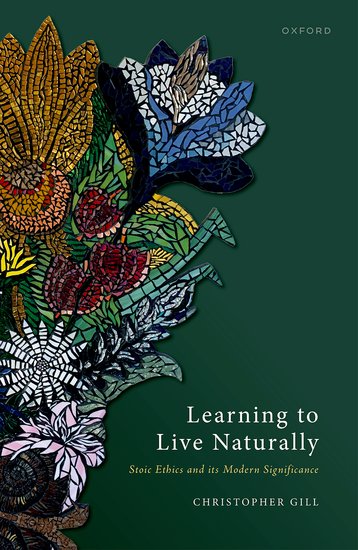
"Learning to Live Naturally"

Coming February 24 from Oxford University Press: Learning to Live Naturally: Stoic Ethics and its Modern Significance by Christopher Gill.

About the book, from the publisher:
At a time of unprecedented interest in Stoicism among scholars and the general public, this book offers a sustained examination of the core Stoic ethical claims and their significance for modern moral theory. The first part considers the Stoic ideas of happiness as the life according to nature and virtue as expertise in leading a happy life and explores the senses of 'nature' (both human and universal) relevant for ethics. The second part studies Stoic thinking on ethical development (learning to live naturally), bringing out the interconnections between growth in ethical understanding, forming social relationships, and emotional responses. The third part discusses how Stoic ethics, as interpreted here, can contribute to contemporary moral theory, especially virtue ethics. It suggests that Stoic thinking on the virtue-happiness relationship offers a cogent alternative to Aristotle, currently the main ancient prototype for virtue ethical theory, and it explores ways in which Stoic ideas on human and universal nature can contribute to modern ethical debates, notably on how to respond effectively to the pressing challenge of climate breakdown. It also highlights the value of Stoic guidance for virtue ethics as well as contemporary 'life-guidance'. A further distinctive feature of the book is the close and extended study of key sources for Stoic ethics, including Cicero's On Ends and On Duties, which enables readers of different kinds to interpret these source for themselves.
--Marshal Zeringue

Thursday, January 12, 2023

"Dark Agoras"

New from NYU Press: Dark Agoras: Insurgent Black Social Life and the Politics of Place by J.T. Roane.

About the book, from the publisher:
A history of Black urban placemaking and politics in Philadelphia from the Great Migration to the era of Black Power

In this book, author J.T. Roane shows how working-class Black communities cultivated two interdependent modes of insurgent assembly—dark agoras—in twentieth century Philadelphia. He investigates the ways they transposed rural imaginaries about and practices of place as part of their spatial resistances and efforts to contour industrial neighborhoods. In acts that ranged from the mundane acts of refashioning intimate spaces to expressly confrontational and liberatory efforts to transform the city’s social and ecological arrangement, these communities challenged the imposition of Progressive and post-Progressive visions for urban order seeking to enclose or displace them.

Under the rubric of dark agoras Roane brings together two formulations of collectivity and belonging associated with working-class Black life. While on their surface diametrically opposed, the city’s underground—its illicit markets, taverns, pool halls, unlicensed bars, as well as spaces housing illicit sex and informal sites like corners associated with the economically and socially disreputable--constituted a spatial and experiential continuum with the city’s set apart—its house meetings, storefronts, temples, and masjid, as well as the extensive spiritually appropriated architectures of the interwar mass movements that included rural land experiments as well as urban housing, hotels, and recreational facilities. Together these sites incubated Black queer urbanism, or dissident visions for urban life challenging dominant urban reform efforts and their modes of producing race, gender, and ultimately the city itself. Roane shows how Black communities built a significant if underappreciated terrain of geographic struggle shaping Philadelphia between the Great Migration and Black Power. This fascinating book will help readers appreciate the importance of Black spatial imaginaries and worldmaking in shaping matters of urban place and politics.
Follow J.T. Roane on Twitter.

--Marshal Zeringue

Wednesday, January 11, 2023

"The Culture Trap"

New from Oxford University Press: The Culture Trap: Ethnic Expectations and Unequal Schooling for Black Youth by Derron Wallace.

About the book, from the publisher:
In The Culture Trap, Derron Wallace argues that the overreliance on culture to explain Black students' achievement and behavior in schools is a trap that undermines the historical factors and institutional processes that shape how Black students experience schooling. This trap is consequential for a host of racial and ethnic minority youth in schools, including Black Caribbean young people in London and New York City. Since the 1920s, Black Caribbeans in New York have been considered a high-achieving Black model minority. Conversely, since the 1950s, Black Caribbeans in London have been regarded as a chronically underachieving minority. In both contexts, however, it is often suggested that Caribbean culture informs their status, whether as a celebrated minority in the US or as a demoted minority in Britain.

Drawing on rich ethnographic observations, as well as interview and archival data from two of the largest public schools in London and New York City, Wallace interrogates the fault lines of these claims, and highlights the influence of colonialism, class, and context in shaping Black Caribbeans' educational experiences. As racial and ethnic achievement gaps and discussions about what to do about them persist in the US and Britain, Wallace shows how culture is at times used as an alibi for racism in schools, and points out what educators, parents, and students can do to change it.
--Marshal Zeringue