Thursday, March 10, 2022

"What Do We Mean When We Talk about Meaning?"

New from Oxford University Press: What Do We Mean When We Talk about Meaning? by Steven Cassedy.

About the book, from the publisher:
A comprehensive journey through the history of "meaning," from antiquity to modern day.

The word meaning appears often in our daily lives: religious leaders holding out the promise of meaning for their followers, self-help manuals seeking to demonstrate the power of meaning to enrich our lives, and most frequently people questioning the meaning of life. The word carries a multitude of connotations, from "purpose" to "value" and "essence" to "mysterious truth", but this diversity of understanding is rarely explored.

In What Do We Mean When We Talk About Meaning?, Steven Cassedy tells the story of how a word that began by denoting "signifying" and "intending" came to acquire such a broad array of sub-definitions. The book begins with the early Christian thinkers who believed meaning could be "read" from the world as if it were holy scripture, then moves into the philosophers who adapted this notion and eventually the Romantic-era Germans that coined "the meaning of life," a phrase that later traveled to Great Britain, the United States, and Russia. The book also extends into the twentieth century, when "meaning" acquired its greatest power in the realms of religion, psychotherapy, and self-help, all of which helped it to accumulate the fluidity and ambiguity it still displays today.
Visit Steven Cassedy's website.

The Page 99 Test: Connected.

My Book, The Movie: Connected.

--Marshal Zeringue

Wednesday, March 9, 2022

"This Earthly Frame"

New from Yale University Press: This Earthly Frame: The Making of American Secularism by David Sehat.

About the book, from the publisher:
An award-winning scholar’s sweeping history of American secularism, from Jefferson to Trump

In This Earthly Frame, David Sehat narrates the making of American secularism through its most prominent proponents and most significant detractors. He shows how its foundations were laid in the U.S. Constitution and how it fully emerged only in the twentieth century. Religious and nonreligious Jews, liberal Protestants, apocalyptic sects like the Jehovah’s Witnesses, and antireligious activists all used the courts and the constitutional language of the First Amendment to create the secular order. Then, over the past fifty years, many religious conservatives turned against that order, emphasizing their religious freedom.

Avoiding both polemic and lament, Sehat offers a powerful reinterpretation of American secularism and a clear framework for understanding the religiously infused conflict of the present.
Visit David Sehat's website.

The Page 99 Test: The Myth of American Religious Freedom.

--Marshal Zeringue

Tuesday, March 8, 2022

"Majority Minority"

New from Oxford University Press: Majority Minority by Justin Gest.

About the book, from the publisher:
How do societies respond to great demographic change? This question lingers over the contemporary politics of the United States and other countries where persistent immigration has altered populations and may soon produce a majority minority milestone, where the original ethnic or religious majority loses its numerical advantage to one or more foreign-origin minority groups. Until now, most of our knowledge about largescale responses to demographic change has been based on studies of individual people's reactions, which tend to be instinctively defensive and intolerant. We know little about why and how these habits are sometimes tempered to promote more successful coexistence.

To anticipate and inform future responses to demographic change, Justin Gest looks to the past. In Majority Minority, Gest wields historical analysis and interview-based fieldwork inside six of the world's few societies that have already experienced a majority minority transition to understand what factors produce different social outcomes. Gest concludes that, rather than yield to people's prejudices, states hold great power to shape public responses and perceptions of demographic change through political institutions and the rhetoric of leaders. Through subsequent survey research, Gest also identifies novel ways that leaders can leverage nationalist sentiment to reduce the appeal of nativism--by framing immigration and demographic change in terms of the national interest. Grounded in rich narratives and surprising survey findings, Majority Minority reveals that this contentious milestone and its accompanying identity politics are ultimately subject to unifying or divisive governance.
Visit Justin Gest's website.

--Marshal Zeringue

Monday, March 7, 2022

"Academic Apartheid"

New from the University of California Press: Academic Apartheid: Race and the Criminalization of Failure in an American Suburb by Sean J. Drake.

About the book, from the publisher:
In Academic Apartheid, sociologist Sean J. Drake addresses long-standing problems of educational inequality from a nuanced perspective, looking at how race and class intersect to affect modern school segregation. Drawing on more than two years of ethnographic observation and dozens of interviews at two distinct high schools in a racially diverse Southern California suburb, Drake unveils hidden institutional mechanisms that lead to the overt segregation and symbolic criminalization of Black, Latinx, and lower-income students who struggle academically. His work illuminates how institutional definitions of success contribute to school segregation, how institutional actors leverage those definitions to justify inequality, and the ways in which local immigrant groups use their ethnic resources to succeed. Academic Apartheid represents a new way forward for scholars whose work sits at the intersection of education, race and ethnicity, class, and immigration.
--Marshal Zeringue

Sunday, March 6, 2022

"The Virtues of Limits"

New from Oxford University Press: The Virtues of Limits by David McPherson.

About the book, from the publisher:
Human beings seek to transcend limits. This is part of our potential greatness, since it is how we can realize what is best in our humanity. However, the limit-transcending feature of human life is also part of our potential downfall, as it can lead to dehumanization and failure to attain important human goods and to prevent human evils. Exploring the place of limits within a well-lived human life this work develops and defends an original account of limiting virtues, which are concerned with recognizing proper limits in human life. The limiting virtues that are the focus are humility, reverence, moderation, contentment, neighborliness, and loyalty, and they are explored in relation to four kinds of limits: existential limits, moral limits, political limits, and economic limits. These virtues have been underexplored in discussions about virtue ethics, and when they have been explored it has not been with regard to the general issue of the place of limits within a well-lived human life. The account of the limiting virtues provided here, however, is intended as a counter to other prominent approaches to ethics: namely, autonomy-centered approaches and consequentialist (or maximizing) approaches. This account is also used to address a number of important contemporary issues such as genetic engineering, distributive justice, cosmopolitanism vs. patriotism, and the ethical status of growth-based economics.
Follow David McPherson on Twitter.

--Marshal Zeringue

Saturday, March 5, 2022

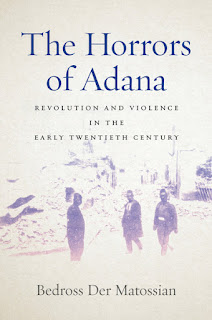
"The Horrors of Adana"

New from Stanford University Press: The Horrors of Adana: Revolution and Violence in the Early Twentieth Century by Bedross Der Matossian.

About the book, from the publisher:
In April 1909, twin massacres shook the province of Adana, located in the southern Anatolia region of modern-day Turkey, killing more than 20,000 Armenians and 2,000 Muslims. The central Ottoman government failed to prosecute the main culprits, a miscarriage of justice that would have repercussions for years to come. Despite the significance of these events and the extent of violence and destruction, the Adana Massacres are often left out of historical narratives. The Horrors of Adana offers one of the first close examinations of these events, analyzing sociopolitical and economic transformations that culminated in a cataclysm of violence.

Bedross Der Matossian provides voice and agency to all involved in the massacres—perpetrators, victims, and bystanders. Drawing on primary sources in a dozen languages, he develops an interdisciplinary approach to understand the rumors and emotions, public spheres and humanitarian interventions that together informed this complex event. Ultimately, through consideration of the Adana Massacres in micro-historical detail, this book offers an important macrocosmic understanding of ethnic violence, illuminating how and why ordinary people can become perpetrators.
Follow Bedross Der Matossian on Twitter.

--Marshal Zeringue

Friday, March 4, 2022

"Disorder: Hard Times in the 21st Century"

New from Oxford University Press: Disorder: Hard Times in the 21st Century by Helen Thompson.

About the book, from the publisher:
Getting to grips with the overlapping geopolitical, economic, and political crises faced by Western democratic societies in the 2020s.

The 21st century has brought a powerful tide of geopolitical, economic, and democratic shocks. Their fallout has led central banks to create over $25 trillion of new money, brought about a new age of geopolitical competition, destabilised the Middle East, ruptured the European Union, and exposed old political fault lines in the United States.

Disorder: Hard Times in the 21st Century is a long history of this present political moment. It recounts three histories - one about geopolitics, one about the world economy, and one about western democracies - and explains how in the years of political disorder prior to the pandemic the disruption in each became one big story. It shows how much of this turbulence originated in problems generated by fossil-fuel energies, and it explains why as the green transition takes place the long-standing predicaments energy invariably shapes will remain in place.
Follow Helen Thompson on Twitter.

--Marshal Zeringue

Thursday, March 3, 2022

"Last Call at the Hotel Imperial"

New from Random House: Last Call at the Hotel Imperial: The Reporters Who Took On a World at War by Deborah Cohen.

About the book, from the publisher:
A prize-winning historian’s revelatory account of a close-knit band of wildly famous American reporters who, in the run-up to World War II, took on dictators and rewrote the rules of modern journalism

They were an astonishing group: glamorous, gutsy, and irreverent to the bone. As cub reporters in the 1920s, they roamed across a war-ravaged world, sometimes perched atop mules on wooden saddles, sometimes gliding through countries in the splendor of a first-class sleeper car. While empires collapsed and fledgling democracies faltered, they chased deposed empresses, international financiers, and Balkan gun-runners, and then knocked back doubles late into the night.

Last Call at the Hotel Imperial is the extraordinary story of John Gunther, H. R. Knickerbocker, Vincent Sheean, and Dorothy Thompson. In those tumultuous years, they landed exclusive interviews with Hitler and Mussolini, Nehru and Gandhi, and helped shape what Americans knew about the world. Alongside these backstage glimpses into the halls of power, they left another equally incredible set of records. Living in the heady afterglow of Freud, they subjected themselves to frank, critical scrutiny and argued about love, war, sex, death, and everything in between.

Plunged into successive global crises, Gunther, Knickerbocker, Sheean, and Thompson could no longer separate themselves from the turmoil that surrounded them. To tell that story, they broke long-standing taboos. From their circle came not just the first modern account of illness in Gunther’s Death Be Not Proud—a memoir about his son’s death from cancer—but the first no-holds-barred chronicle of a marriage: Sheean’s Dorothy and Red, about Thompson’s fractious relationship with Sinclair Lewis.

Told with the immediacy of a conversation overheard, this revelatory book captures how the global upheavals of the twentieth century felt up close.
Visit Deborah Cohen's website.

Writers Read: Deborah Cohen (March 2013).

--Marshal Zeringue

Wednesday, March 2, 2022

"Solidarity in Conflict"

New from Stanford University Press: Solidarity in Conflict: A Democratic Theory by Rochelle DuFord.

About the book, from the publisher:
Democracy has become disentangled from our ordinary lives. Mere cooperation or ethical consumption now often stands in for a robust concept of solidarity that structures the entirety of sociality and forms the basis of democratic culture. How did democracy become something that is done only at ballot boxes and what role can solidarity play in reviving it? In Solidarity in Conflict, Rochelle DuFord presents a theory of solidarity fit for developing democratic life and a complementary theory of democracy that emerges from a society typified by solidarity.

DuFord argues that solidarity is best understood as a set of relations, one agonistic and one antagonistic: the solidarity groups' internal organization and its interactions with the broader world. Such a picture of solidarity develops through careful consideration of the conflicts endemic to social relations and solidarity organizations. Examining men's rights groups, labor organizing's role in recognitional protections for LGBTQ members of society, and the debate over trans inclusion in feminist praxis, DuFord explores how conflict, in these contexts, becomes the locus of solidarity's democratic functions and thereby critiques democratic theorizing for having become either overly idealized or overly focused on building and maintaining stability. Working in the tradition of the Frankfurt School, DuFord makes a provocative case that the conflict generated by solidarity organizations can address a variety of forms of domination, oppression, and exploitation while building a democratic society.
Visit Rochelle DuFord's website.

--Marshal Zeringue

Tuesday, March 1, 2022

"Ukraine's Revolt, Russia's Revenge"

New from Brookings Institution Press: Ukraine's Revolt, Russia's Revenge by Christopher M. Smith.

About the book, from the publisher:
An eyewitness account by a U.S. diplomat of Russia’s brazen attempt to undo the democratic revolution in Ukraine

Told from the perspective of a U.S. diplomat in Kyiv, this book is the true story of Ukraine’s anti-corruption revolution in 2013—14, Russia’s intervention and invasion of that nation, and the limited role played by the United States. It puts into a readable narrative the previously unpublished reporting by seasoned U.S. diplomatic and military professionals, a wealth of information on Ukrainian high-level and street-level politics, a broad analysis of the international context, and vivid descriptions of people and places in Ukraine during the EuroMaidan Revolution. The book also counters Russia’s disinformation narratives about the revolution and America’s role in it. While focusing on a single country during a dramatic three-year period, the book’s universal themes—among them, truth versus lies, democracy versus autocracy—possess a broader urgency for our times. That urgency burns particularly hot for the United States and all other countries that are the targets of Russia's cyber warfare and other forms of political skullduggery.

From his posting in U.S. Embassy Kyiv (2012–14), the author observed and reported first-hand on the EuroMaidan Revolution that wrested power from corrupt pro-Kremlin Ukrainian autocrat Viktor Yanukovych.

The book also details Russia’s attempt to abort the Ukrainian revolution through threats, economic pressure, lies, and intimidation. When all of that failed, the Kremlin exacted revenge by annexing Ukraine's territory of Crimea and fomenting and sustaining a hybrid war in eastern Ukraine that has killed more than 13,000 people and continues to this day.

Ukraine's Revolt, Russia’s Revenge is based on the author’s own observations and the multitude of reports of his Embassy colleagues who were eyewitnesses to a crucial event in contemporary history.
--Marshal Zeringue