Wednesday, September 30, 2015

"The Cherokee Diaspora"

Featured at Yale University Press: The Cherokee Diaspora: An Indigenous History of Migration, Resettlement, and Identity by Gregory D. Smithers.

About the book, from the publisher:
The Cherokee are one of the largest Native American tribes in the United States, with more than three hundred thousand people across the country claiming tribal membership and nearly one million people internationally professing to have at least one Cherokee Indian ancestor. In this revealing history of Cherokee migration and resettlement, Gregory Smithers uncovers the origins of the Cherokee diaspora and explores how communities and individuals have negotiated their Cherokee identities, even when geographically removed from the Cherokee Nation headquartered in Tahlequah, Oklahoma. Beginning in the eighteenth century, the author transports the reader back in time to tell the poignant story of the Cherokee people migrating throughout North America, including their forced exile along the infamous Trail of Tears (1838–39). Smithers tells a remarkable story of courage, cultural innovation, and resilience, exploring the importance of migration and removal, land and tradition, culture and language in defining what it has meant to be Cherokee for a widely scattered people.
--Marshal Zeringue

Tuesday, September 29, 2015

"Walter Camp: Football and the Modern Man"

New from Oxford University Press: Walter Camp: Football and the Modern Man by Julie Des Jardins.

About the book, from the publisher:
Americans are obsessed with football, yet they know little about the man who shaped the game to make it uniquely technical, physical, and 'man-making' at once. Walter Camp, the "Father of American Football," was the foremost authority on American athletics and arguably the greatest amateur American athlete of his time.

In Walter Camp: Football and the Modern Man, Julie Des Jardins chronicles the life of the clock company executive and self-made athlete who remade football and redefined the ideal man. As a student at Yale University, Camp was a varsity letterman who led the earliest efforts to codify the rules and organization of football-including the line of scrimmage and "downs"-to make it distinct from English rugby. He also invented the All-America Football Team and wrote some of the first football fiction, guides, and sports page coverage, making him the foremost popularizer of the game. Within a decade American football was an obsession on college campuses of the Northeast. By the turn of the century, it was a bona fide national pastime.

Since the Civil War, college men of good breeding had not a physical skirmish to harden them. They had grown soft, Americans feared, both in body and attitude. Camp saw football as the antidote to the degeneration of these young men. When massive numbers of college football players enlisted to fight in World War I, Camp held them up as proof that football turned men effective and courageous. His influence over the game, however, was not always viewed as beneficial. Under his watch, dozens of college and high school players were killed or maimed on the gridiron. President Theodore Roosevelt urged him to reform football to prevent administrators from banning it, but Camp was ambivalent about removing the very physicality that made the game man-making in his eyes. The criticism targeted at him over the aggressiveness of football still haunts the game today.

In this fast-paced biography, Julie Des Jardins shows how the "gentleman athlete" was as much the arbiter of football as he was the arbiter of modern manhood. Though eventually football took on meanings that Camp never intended, his impact on the professional and college game is simply unsurpassed.
Visit Julie Des Jardins's website.

--Marshal Zeringue

Monday, September 28, 2015

"Sailing the Water’s Edge"

New from Princeton University Press: Sailing the Water’s Edge: The Domestic Politics of American Foreign Policy by Helen V. Milner & Dustin Tingley.

About the book, from the publisher:
When engaging with other countries, the U.S. government has a number of different policy instruments at its disposal, including foreign aid, international trade, and the use of military force. But what determines which policies are chosen? Does the United States rely too much on the use of military power and coercion in its foreign policies? Sailing the Water’s Edge focuses on how domestic U.S. politics—in particular the interactions between the president, Congress, interest groups, bureaucratic institutions, and the public—have influenced foreign policy choices since World War II and shows why presidents have more control over some policy instruments than others. Presidential power matters and it varies systematically across policy instruments.

Helen Milner and Dustin Tingley consider how Congress and interest groups have substantial material interests in and ideological divisions around certain issues and that these factors constrain presidents from applying specific tools. As a result, presidents select instruments that they have more control over, such as use of the military. This militarization of U.S. foreign policy raises concerns about the nature of American engagement, substitution among policy tools, and the future of U.S. foreign policy. Milner and Tingley explore whether American foreign policy will remain guided by a grand strategy of liberal internationalism, what affects American foreign policy successes and failures, and the role of U.S. intelligence collection in shaping foreign policy. The authors support their arguments with rigorous theorizing, quantitative analysis, and focused case studies, such as U.S. foreign policy in Sub-Saharan Africa across two presidential administrations.

Sailing the Water’s Edge examines the importance of domestic political coalitions and institutions on the formation of American foreign policy.
--Marshal Zeringue

Sunday, September 27, 2015

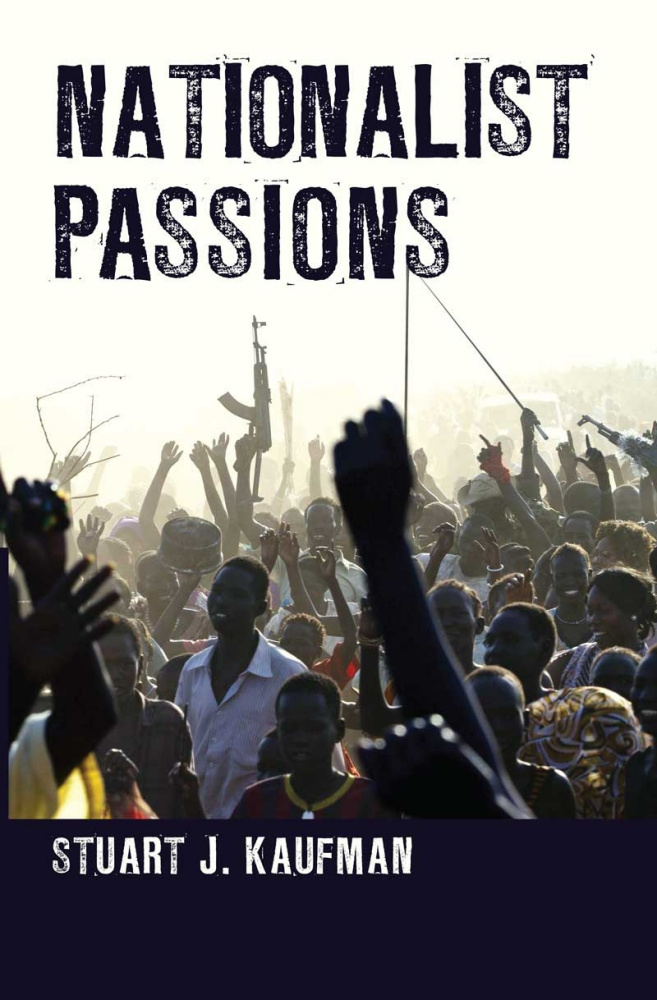
"Nationalist Passions"

New from Cornell University Press: Nationalist Passions by Stuart J. Kaufman.

About the book, from the publisher:
Nationalist and ethnic conflict can take many forms, from genocidal violence and civil war to protest movements and peaceful squabbles in democracies. Nationalist Passions poses a stark challenge to extreme rationalist understandings of political conflict. Stuart J. Kaufman elaborates a compelling theory of ethnic politics to explain why ethnic violence erupts in some contexts and how peace is maintained in others. At the core of Kaufman's theory is an assertion that conflicts are initiated due to popular "symbolic predispositions"—biases of all kinds—and perceptions of threat.

Kaufman puts his theory to the test in a range of conflicts. He examines some highly violent episodes, among them the Muslim rebellion in the southern Philippines beginning in the 1970s; the civil war in southern Sudan that began in the 1980s; and the Rwanda genocide of 1994. Kaufman also analyzes other situations in which leaders attempted to tame the violence that nationalist passions can generate. In India, Mahatma Gandhi mobilized an overtly nonviolent movement but failed in his efforts to prevent the rise of Muslim-Hindu communal violence. In South Africa, Nelson Mandela and F. W. de Klerk ended apartheid, but not without terrible cost—more than fifteen thousand people died while the negotiations were under way. In Tanzania, however, Julius Nyerere led one of the few ethnically diverse countries in the world with almost no ethnic violence. Nationalist Passions is essential reading for policymakers, international aid workers, and all others who seek to find the best possible outcomes for future internal and interstate clashes.
--Marshal Zeringue

Saturday, September 26, 2015

"Houses for a New World"

New from Princeton University Press: Houses for a New World: Builders and Buyers in American Suburbs, 1945–1965 by Barbara Miller Lane.

About the book, from the publisher:
While the work of Frank Lloyd Wright, Richard Neutra, and their contemporaries frequently influences our ideas about house design at the midcentury, most Americans during this period lived in homes built by little-known builders who also served as developers of the communities. Often dismissed as “little boxes, made of ticky-tacky,” the tract houses of America’s postwar suburbs represent the twentieth century’s most successful experiment in mass housing. Houses for a New World is the first comprehensive history of this uniquely American form of domestic architecture and urbanism.

Between 1945 and 1965, more than thirteen million houses—most of them in new ranch and split-level styles—were constructed on large expanses of land outside city centers, providing homes for the country’s rapidly expanding population. Focusing on twelve developments in the suburbs of Boston, Philadelphia, Chicago, and Los Angeles, Barbara Miller Lane tells the story of the collaborations between builders and buyers, showing how both wanted houses and communities that espoused a modern way of life—informal, democratic, multiethnic, and devoted to improving the lives of their children. The resulting houses differed dramatically from both the European International Style and older forms of American domestic architecture.

Based on a decade of original research, and accompanied by hundreds of historical images, plans, and maps, this book presents an entirely new interpretation of the American suburb. The result is a fascinating history of houses and developments that continue to shape how tens of millions of Americans live.
--Marshal Zeringue

Friday, September 25, 2015

"Trafficking Justice"

New from Cornell University Press: Trafficking Justice: How Russian Police Enforce New Laws, from Crime to Courtroom by Lauren A. McCarthy.

About the book, from the publisher:
In response to a growing human trafficking problem and domestic and international pressure, human trafficking and the use of slave labor were first criminalized in Russia in 2003. In Trafficking Justice, Lauren A. McCarthy explains why Russian police, prosecutors, and judges have largely ignored this new weapon in their legal arsenal, despite the fact that the law was intended to make it easier to pursue trafficking cases.

Using a combination of interview data, participant observation, and an original dataset of more than 5,500 Russian news media articles on human trafficking cases, McCarthy explores how trafficking cases make their way through the criminal justice system, covering multiple forms of the crime—sexual, labor, and child trafficking—over the period 2003–2013. She argues that to understand how law enforcement agencies have dealt with trafficking, it is critical to understand how their "institutional machinery"—the incentives, culture, and structure of their organizations—channels decision-making on human trafficking cases toward a familiar set of routines and practices and away from using the new law. As a result, law enforcement often chooses to charge and prosecute traffickers with related crimes, such as kidnapping or recruitment into prostitution, rather than under the 2003 trafficking law because these other charges are more familiar and easier to bring to a successful resolution. In other words, after ten years of practice, Russian law enforcement has settled on a policy of prosecuting traffickers, not trafficking.
--Marshal Zeringue

Thursday, September 24, 2015

"Empire and Revolution"

New from Princeton University Press: Empire and Revolution: The Political Life of Edmund Burke by Richard Bourke.

About the book, from the publisher:
Edmund Burke (1730–97) lived during one of the most extraordinary periods of world history. He grappled with the significance of the British Empire in India, fought for reconciliation with the American colonies, and was a vocal critic of national policy during three European wars. He also advocated reform in Britain, pressed for constitutional change in Ireland, and became a central protagonist in the great debate on the French Revolution. Drawing on the complete range of printed and manuscript sources, Empire and Revolution offers a vivid reconstruction of the major concerns of this outstanding statesman, orator, and philosopher.

In restoring Burke to his original political and intellectual context, this book strips away the accumulated distortions that have marked the reception of his ideas. In the process, it overturns the conventional picture of a partisan of tradition against progress. In place of the image of a backward-looking opponent of popular rights, it presents a multifaceted portrait of one of the most captivating figures in eighteenth-century life and thought. While Burke was a passionately energetic statesman, he was also a deeply original thinker. Empire and Revolution depicts him as a philosopher-in-action who evaluated the political realities of the day through the lens of Enlightenment thought, variously drawing on the ideas of such figures as Montesquieu, Rousseau, and Hume.

A boldly ambitious work of scholarship, this book challenges us to rethink the legacy of Burke and the turbulent era in which he played so pivotal a role.
--Marshal Zeringue

Wednesday, September 23, 2015

"Lincoln in the Atlantic World"

New from Cambridge University Press: Lincoln in the Atlantic World by Louise L. Stevenson.

About the book, from the publisher:
This original and wide-ranging work reveals how Abraham Lincoln responded to prompts from around the globe to shape his personal appearance, political appeal, and presidential policies. Throughout his life, he learned lessons about slavery, American politics, and international relations from sources centered in Africa, Britain, and the European continent. Answering questions that previous scholars have not thought to ask, the book opens the vision of Lincoln as a global republican. Thanks to its new stories and compelling analyses, this book provides a provocative and stimulating read that will generate debate at both high and popular levels.
Louise L. Stevenson is a professor of history and American studies at Franklin & Marshall College.

--Marshal Zeringue

"The Mushroom at the End of the World"

New from Princeton University Press: The Mushroom at the End of the World: On the Possibility of Life in Capitalist Ruins by Anna Lowenhaupt Tsing.

About the book, from the publisher:
Matsutake is the most valuable mushroom in the world—and a weed that grows in human-disturbed forests across the northern hemisphere. Through its ability to nurture trees, matsutake helps forests to grow in daunting places. It is also an edible delicacy in Japan, where it sometimes commands astronomical prices. In all its contradictions, matsutake offers insights into areas far beyond just mushrooms and addresses a crucial question: what manages to live in the ruins we have made?

A tale of diversity within our damaged landscapes, The Mushroom at the End of the World follows one of the strangest commodity chains of our times to explore the unexpected corners of capitalism. Here, we witness the varied and peculiar worlds of matsutake commerce: the worlds of Japanese gourmets, capitalist traders, Hmong jungle fighters, industrial forests, Yi Chinese goat herders, Finnish nature guides, and more. These companions also lead us into fungal ecologies and forest histories to better understand the promise of cohabitation in a time of massive human destruction.

By investigating one of the world’s most sought-after fungi, The Mushroom at the End of the World presents an original examination into the relation between capitalist destruction and collaborative survival within multispecies landscapes, the prerequisite for continuing life on earth.
--Marshal Zeringue

Tuesday, September 22, 2015

"Magic in Western Culture"

New from Cambridge University Press: Magic in Western Culture: From Antiquity to the Enlightenment by Brian P. Copenhaver.

About the book, from the publisher:
The story of the beliefs and practices called 'magic' starts in ancient Iran, Greece, and Rome, before entering its crucial Christian phase in the Middle Ages. Centering on the Renaissance and Marsilio Ficino – whose work on magic was the most influential account written in premodern times – this groundbreaking book treats magic as a classical tradition with foundations that were distinctly philosophical. Besides Ficino, the premodern story of magic also features Plotinus, Iamblichus, Proclus, Aquinas, Agrippa, Pomponazzi, Porta, Bruno, Campanella, Descartes, Boyle, Leibniz, and Newton, to name only a few of the prominent thinkers discussed in this book. Because pictures play a key role in the story of magic, this book is richly illustrated.
Brian P. Copenhaver is Distinguished Professor and Udvar-Hazy Chair of Philosophy and History at the University of California, Los Angeles.

--Marshal Zeringue