Friday, November 10, 2023

"Musical Models of Democracy"

New from Oxford University Press: Musical Models of Democracy by Robert Adlington.

About the book, from the publisher:
Music's role in animating democracy--whether through protests and demonstrations, as a vehicle for political identity, or as a means of overcoming social divides--is well understood. Yet musicians have also been drawn to the potential of embodying democracy itself through musical processes and relationships. In this book, author Robert Adlington uses modern democratic theory to explore what he terms the 'musical modelling of democracy' as manifested in modern and experimental music of the global North.

Throughout the book, Adlington demonstrates how composers and musicians have taken strikingly different approaches to this kind of musical modelling. For some, democratic principles inform the textural relationships inscribed into musical scores, as in the case of Elliott Carter's 'polyvocal' compositions. Pioneers of musical indeterminacy sought to democratise the relationship between composer and performers by leaving open key decisions about the realisation of a work. Musicians have involved audiences in active participation to liberate them from the passivity of spectatorship. Free improvisation groups have experimented with new kinds of egalitarian relationships between performers to reject old hierarchies. In examining these different approaches, Adlington illuminates the achievements and ambiguities of musical models of democracy.

As a result, this book not only offers an important new perspective on modern musicians' engagement with a central political idea of the past century, but it also encourages a deeper and more critical engagement with the idea of democracy within present-day musical life.
--Marshal Zeringue

Thursday, November 9, 2023

"The Kings of Algiers"

New from Princeton University Press: The Kings of Algiers: How Two Jewish Families Shaped the Mediterranean World during the Napoleonic Wars and Beyond by Julie Kalman.

About the book, from the publisher:
A richly detailed history of the Bacris and the Busnachs, two renowned Jewish families whose influence and reputation shook the capitals of Europe and America

At the height of the Napoleonic Wars, the Bacri brothers and their nephew, Naphtali Busnach, were perhaps the most notorious Jews in the Mediterranean. Based in the strategic port of Algiers, their interconnected families traded in raw goods and luxury items, brokered diplomatic relations with the Ottomans, and lent vital capital to warring nations. For the French, British, and Americans, who competed fiercely for access to trade and influence in the region, there was no getting around the Bacris and the Busnachs. The Kings of Algiers traces the rise and fall of these two trading families over four tumultuous decades in the nineteenth century.

In this panoramic book, Julie Kalman restores their story―and Jewish history more broadly―to the histories of trade, corsairing, and high-stakes diplomacy in the Mediterranean during the Napoleonic Wars and their aftermath. Jacob Bacri dined with Napoleon himself. Thomas Jefferson, James Madison, and Horatio Nelson considered strategies to circumvent the Bacris’ influence. As the families’ ambitions grew, so did the perils, from imprisonment and assassination to fraud and family collapse.

The Kings of Algiers brings vividly to life an age of competitive imperialism and nascent nationalism and demonstrates how people and events on the periphery shaped perceptions and decisions in the distant metropoles of the world’s great nations.
--Marshal Zeringue

Wednesday, November 8, 2023

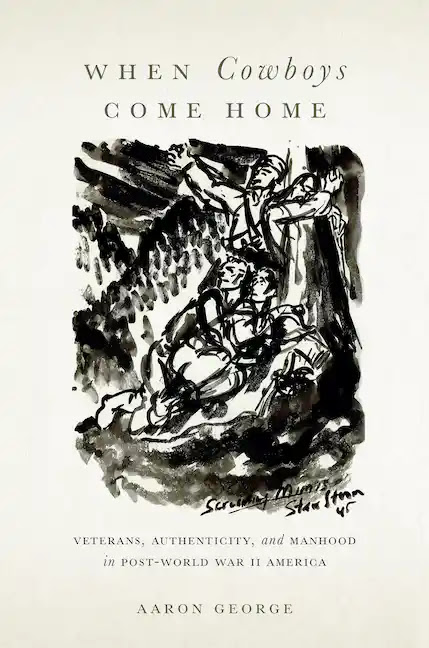
"When Cowboys Come Home"

New from Rutgers University Press: When Cowboys Come Home: Veterans, Authenticity, and Manhood in Post–World War II America by Aaron George.

About the book, from the publisher:
When Cowboys Come Home: Veterans, Authenticity, and Manhood in Post–World War II America is a cultural and intellectual history of the 1950s that argues that World War II led to a breakdown of traditional markers of manhood and opened space for veterans to reimagine what masculinity could mean. One particularly important strand of thought, which influenced later anxieties over “other-direction” and “conformity,” argued that masculinity was not defined by traits like bravery, stoicism, and competitiveness but instead by authenticity, shared camaraderie, and emotional honesty. To elucidate this challenge to traditional “frontiersman” masculinity, Aaron George presents three intellectual biographies of important veterans who became writers after the war: James Jones, the writer of the monumentally important war novel From Here to Eternity; Stewart Stern, one of the most important screenwriters of the fifties and sixties, including for Rebel without a Cause; and Edward Field, a bohemian poet who used poetry to explore his love for other men. Through their lives, George shows how wartime disabused men of the notion that war was inherently a brave or heroic enterprise and how the alienation they felt upon their return led them to value the authentic connections they made with other men during the war.
--Marshal Zeringue

Tuesday, November 7, 2023

"The Muslim Secular"

New from Oxford University Press: The Muslim Secular: Parity and the Politics of India's Partition by Amar Sohal.

About the book, from the publisher:
Concerned with the fate of the minority in the age of the nation-state, Muslim political thought in modern South Asia has often been associated with religious nationalism and the creation of Pakistan. The Muslim Secular complicates that story by reconstructing the ideas of three prominent thinker-actors of the Indian freedom struggle: the Indian National Congress leader Abul Kalam Azad, the popular Kashmiri politician Sheikh Abdullah, and the nonviolent Pashtun activist Abdul Ghaffar Khan. Revising the common view that they were mere acolytes of their celebrated Hindu colleagues M.K. Gandhi and Jawaharlal Nehru, this book argues that these three men collectively produced a distinct Muslim secularity from within the grander family of secular Indian nationalism; an intellectual tradition that has retained religion within the public space while nevertheless preventing it from defining either national membership or the state. At a time when many across the decolonising world believed that identity-based majorities and minorities were incompatible and had to be separated out into sovereign equals, Azad, Abdullah, and Ghaffar Khan thought differently about the problem of religious pluralism in a postcolonial democracy. The minority, they contended, could conceive of the majority not just as an antagonistic entity that is set against it, but to which it can belong and uniquely complete. Premising its claim to a single, united India upon the universalism of Islam, champions of the Muslim secular mobilised notions of federation and popular sovereignty to replace older monarchical and communitarian forms of power. But to finally jettison the demographic inequality between Hindus and Muslims, these thinkers redefined equality itself. Rejecting its liberal definition for being too abstract and thus prone to majoritarian assimilation, they replaced it with their own rendition of Indian parity to simultaneously evoke commonality and distinction between Hindu and Muslim peers. Azad, Abdullah, and Ghaffar Khan achieved this by deploying a range of concepts from profane inheritance and theological autonomy to linguistic diversity and ethical pledges. Retaining their Muslimness and Indian nationality in full, this crowning notion of equality-as-parity challenged both Gandhi and Nehru's abstractions and Mohammad Ali Jinnah's supposedly dangerous demand for Pakistan.
--Marshal Zeringue

Monday, November 6, 2023

"Feeling Their Pain"

New from Oxford University Press: Feeling Their Pain: Why Voters Want Leaders Who Care by Jared McDonald.

About the book, from the publisher:
The 2020 Presidential Election in the United States marked, for many, a return to "compassionate politics." Joe Biden had run on a platform of empathy, emphasizing his personal history as a means of connecting with everyone from American workers who had lost jobs to military families who had lost loved ones. Although perceptions of candidate compassion are broadly understood to influence vote choice, less understood is the question of how candidates convince voters they truly "care about people like them." In Feeling their Pain: Why Voters want Leaders who Care, Jared McDonald provides a framework for understanding why voters view some politicians as more compassionate than others.

McDonald shows that perceptions of compassion in candidates for public office are based on the number and intensity of commonalities that bind citizens to political leaders. Commonalities can come in many forms, such as a shared experience ("I've been through what you've been through"), a shared emotion ("I feel the way you feel"), or a shared identity ("I am who you are"). Compassion is conceptualized through the lens of self-interest. Compassion may be universal, such as when candidates convey empathy to all individuals who are struggling. Or compassion may be exclusionary, such as when candidates express a preference for some groups over others. Thus, the way campaigns choose to wield compassion in their messaging strategies has important implications not only for election outcomes, but for American political polarization as well.
--Marshal Zeringue

Sunday, November 5, 2023

"America's Black Capital"

New from Basic Books: America's Black Capital: How African Americans Remade Atlanta in the Shadow of the Confederacy by Jeffrey O. G. Ogbar.

About the book, from the publisher:
The remarkable story of how African Americans transformed Atlanta, the former heart of the Confederacy, into today’s Black mecca

Atlanta is home to some of America’s most prominent Black politicians, artists, businesses, and HBCUs. Yet, in 1861, Atlanta was a final contender to be the capital of the Confederacy. Sixty years later, long after the Civil War, it was the Ku Klux Klan’s sacred “Imperial City.”

America’s Black Capital chronicles how a center of Black excellence emerged amid virulent expressions of white nationalism, as African Americans pushed back against Confederate ideology to create an extraordinary locus of achievement. What drove them, historian Jeffrey O. G. Ogbar shows, was the belief that Black uplift would be best advanced by forging Black institutions. America’s Black Capital is an inspiring story of Black achievement against all odds, with effects that reached far beyond Georgia, shaping the nation’s popular culture, public policy, and politics.
--Marshal Zeringue

Saturday, November 4, 2023

"Arctic Convoys"

New from Yale University Press: Arctic Convoys: Bletchley Park and the War for the Seas by David Kenyon.

About the book, from the publisher:
An incisive account of the Arctic convoys, and the essential role Bletchley Park and Special Intelligence played in Allied success

Between 1941 and 1945, more than eight hundred shiploads of supplies were delivered to the Soviet Union protected by allied naval forces. Each journey was a battle against the elements, with turbulent seas, extreme cold, and the constant dread of torpedoes. These Arctic convoys have been mythologized as defenseless vessels at the mercy of deadly U-boats—but was this really the case?

David Kenyon explores the story of the war in the Arctic, revealing that the contest was more evenly balanced that previously thought. Battles included major ship engagements, aircraft carriers, and combat between surface ships. Amid this wide range of forces, Bletchley Park’s Naval Section played a decisive role in Arctic operations, with both sides relying heavily on Signals Intelligence to intercept and break each other’s codes. Kenyon presents a vivid picture of the Arctic theater of war, unearthing the full-scale campaign for naval supremacy in northern waters.
--Marshal Zeringue

Friday, November 3, 2023

"The Starving Empire"

New from Cornell University Press: The Starving Empire: A History of Famine in France's Colonies by Yan Slobodkin.

About the book, from the publisher:
The Starving Empire traces the history of famine in the modern French Empire, showing that hunger is intensely local and sweepingly global, shaped by regional contexts and the transnational interplay of ideas and policies all at once. By integrating food crises in Algeria, West and Equatorial Africa, and Vietnam into a broader story of imperial and transnational care, Yan Slobodkin reveals how the French colonial state and an emerging international community took increasing responsibility for subsistence, but ultimately failed to fulfill this responsibility.

Europeans once dismissed colonial famines as acts of god, misfortunes of nature, and the inevitable consequences of backward races living in harsh environments. But as Slobodkin recounts, drawing on archival research from four continents, the twentieth century saw transformations in nutrition, scientific racism, and international humanitarianism that profoundly altered ideas of what colonialism could accomplish. A new confidence in the ability to mitigate hunger, coupled with new norms of moral responsibility, marked a turning point in the French Empire's relationship to colonial subjects―and to nature itself.

Increasingly sophisticated understandings of famine as a technical problem subject to state control saddled France with untenable obligations. The Starving Empire not only illustrates how the painful history of colonial famine remains with us in our current understandings of public health, state sovereignty, and international aid, but also seeks to return food―this most basic of human needs―to its central place in the formation of modern political obligation and humanitarian ethics.
--Marshal Zeringue

Thursday, November 2, 2023

"Weakness of Will and Delay Discounting"

New from Oxford University Press: Weakness of Will and Delay Discounting by Nora Heinzelmann.

About the book, from the publisher:
Breaking one's dieting rule or resolution to quit smoking, procrastination, convenient lies, even the failure of entire nations to follow through with plans to cut greenhouse gas emissions or keep a pandemic in check - these phenomena have been discussed by philosophers and behavioural scientists as examples of weakness of will and delay discounting. Despite the common subject matter both fields have to date rarely worked together for mutual benefit. For the empirical literature is hardly accessible to a reader not familiar with econometric theory; and researchers in the behavioural sciences may find philosophical accounts invoking discounting models difficult to understand without inside knowledge of the debates and historical background.

Nora Heinzelmann targets this lacuna by making the ideas and findings from both disciplines intelligible to outsiders. This reveals that discounting - as philosophers have conceived of it - is neither necessary nor sufficient for weakness of will, even though there is substantial overlap. Heinzelmann develops a richer descriptive account of weakness of will that is based on the empirically founded assumption that weak-willed behaviour is determined by uncertainty about whether or when a good materialises. She also explains why weakness of the will understood in this way is irrational: the agent yields to a cognitive bias that leads them to underestimate the greater good they think they ought to and can obtain. Finally, she explores practical implications for individuals and policymakers.
--Marshal Zeingue

Wednesday, November 1, 2023

"The Accidental Equalizer"

New from the University of Chicago Press: The Accidental Equalizer: How Luck Determines Pay after College by Jessi Streib.

About the book, from the publisher:
A startling discovery—that job market success after college is largely random—forces a reappraisal of education, opportunity, and the American dream.

As a gateway to economic opportunity, a college degree is viewed by many as America’s great equalizer. And it’s true: wealthier, more connected, and seemingly better-qualified students earn exactly the same pay as their less privileged peers. Yet, the reasons why may have little to do with bootstraps or self-improvement—it might just be dumb luck. That’s what sociologist Jessi Streib proposes in The Accidental Equalizer, a conclusion she reaches after interviewing dozens of hiring agents and job-seeking graduates.

Streib finds that luck shapes the hiring process from start to finish in a way that limits class privilege in the job market. Employers hide information about how to get ahead and force students to guess which jobs pay the most and how best to obtain them. Without clear routes to success, graduates from all class backgrounds face the same odds at high pay. The Accidental Equalizer is a frank appraisal of how this “luckocracy” works and its implications for the future of higher education and the middle class. Although this system is far from eliminating American inequality, Streib shows that it may just be the best opportunity structure we have—for better and for worse.
Visit Jessi Streib's website.

The Page 99 Test: Privilege Lost.

--Marshal Zeringue