Thursday, February 9, 2023

"Impermanent Blackness"

New from Princeton University Press: Impermanent Blackness: The Making and Unmaking of Interracial Literary Culture in Modern America by Korey Garibaldi.

About the book, from the publisher:
In Impermanent Blackness, Korey Garibaldi explores interracial collaborations in American commercial publishing—authors, agents, and publishers who forged partnerships across racial lines—from the 1910s to the 1960s. Garibaldi shows how aspiring and established Black authors and editors worked closely with white interlocutors to achieve publishing success, often challenging stereotypes and advancing racial pluralism in the process.

Impermanent Blackness explores the complex nature of this almost-forgotten period of interracial publishing by examining key developments, including the mainstream success of African American authors in the 1930s and 1940s, the emergence of multiracial children’s literature, postwar tensions between supporters of racial cosmopolitanism and of “Negro literature,” and the impact of the Civil Rights and Black Power movements on the legacy of interracial literary culture.

By the end of the 1960s, some literary figures once celebrated for pushing the boundaries of what Black writing could be, including the anthologist W. S. Braithwaite, the bestselling novelist Frank Yerby, the memoirist Juanita Harrison, and others, were forgotten or criticized as too white. And yet, Garibaldi argues, these figures—at once dreamers and pragmatists—have much to teach us about building an inclusive society. Revisiting their work from a contemporary perspective, Garibaldi breaks new ground in the cultural history of race in the United States.
--Marshal Zeringue

Wednesday, February 8, 2023

"Forbidden Intimacies"

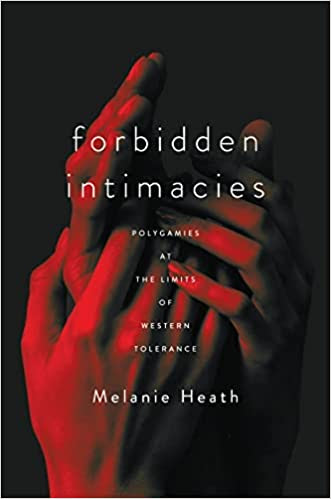
New from Stanford University Press: Forbidden Intimacies: Polygamies at the Limits of Western Tolerance by Melanie Heath.

About the book, from the publisher:
A poignant account of everyday polygamy and what its regulation reveals about who is viewed as an "Other"

In the past thirty years, polygamy has become a flashpoint of conflict as Western governments attempt to regulate certain cultural and religious practices that challenge seemingly central principles of family and justice. In Forbidden Intimacies, Melanie Heath comparatively investigates the regulation of polygamy in the United States, Canada, France, and Mayotte. Drawing on a wealth of ethnographic and archival sources, Heath uncovers the ways in which intimacies framed as "other" and "offensive" serve to define the very limits of Western tolerance. These regulation efforts, counterintuitively, allow the flourishing of polygamies on the ground. The case studies illustrate a continuum of justice, in which some groups, like white fundamentalist Mormons in the U.S., organize to fight against the prohibition of their families' existence, whereas African migrants in France face racialized discrimination in addition to rigid migration policies. The matrix of legal and social contexts, informed by gender, race, sexuality, and class, shapes the everyday experiences of these relationships. Heath uses the term "labyrinthine love" to conceptualize the complex ways individuals negotiate different kinds of relationships, ranging from romantic to coercive. What unites these families is the secrecy in which they must operate. As government intervention erodes their abilities to secure housing, welfare, work, and even protection from abuse, Heath exposes the huge variety of intimacies, and the power they hold to challenge heteronormative, Western ideals of love.
Follow Melanie Heath on Twitter.

--Marshal Zeringue

Tuesday, February 7, 2023

"The Suffragist Peace"

New from Oxford University Press: The Suffragist Peace: How Women Shape the Politics of War by Robert F. Trager and Joslyn N. Barnhart.

About the book, from the publisher:
A deep and historical examination of how the political influence of women at the ballot box has shaped the course of war and peace.

In the modern age, some parts of the world are experiencing a long peace. Nuclear weapons, capitalism and the widespread adoption of democratic institutions have been credited with fostering this relatively peaceful period. Yet, these accounts overlook one of the most dramatic transformations of the 20th century: the massive redistribution of political power as millions of women around the world won the right to vote.

Through gripping history and careful reasoning, this book examines how the political influence of women at the ballot box has shaped war and peace. What would a world ruled by women look like? For more than a hundred years, conventional wisdom held that women's votes had little effect. That view is changing - it turns out that women voters had a profound effect on the world we know and in ways we hardly understand. A world ruled by women's voices is a world that is less willing to fall in love with war as a noble end in itself, less prone to lapse into violence for the sake of maintaining an image. In other words, it is the world we live in now, more so than we have ever realized.
--Marshal Zeringue

Monday, February 6, 2023

"At War with Women"

New from Cornell University Press: At War with Women: Military Humanitarianism and Imperial Feminism in an Era of Permanent War by Jennifer Greenburg.

About the book, from the publisher:
At War with Women reveals how post-9/11 politics of gender and development have transformed US military power. In the mid-2000s, the US military used development as a weapon as it revived counterinsurgency in Iraq and Afghanistan. The military assembled all-female teams to reach households and wage war through development projects in the battle for "hearts and minds." Despite women technically being banned from ground combat units, the all-female teams were drawn into combat nonetheless. Based on ethnographic fieldwork observing military trainings, this book challenges liberal feminist narratives that justified the Afghanistan War in the name of women's rights and celebrated women's integration into combat as a victory for gender equality.

Jennifer Greenburg critically interrogates a new imperial feminism and its central role in securing US hegemony. Women's incorporation into combat through emotional labor has reinforced gender stereotypes, with counterinsurgency framing female soldiers as global ambassadors for women's rights. This book provides an analysis of US imperialism that keeps the present in tension with the past, clarifying where colonial ideologies of race, gender, and sexuality have resurfaced and how they are changing today.
Follow Jennifer Greenburg on Twitter.

--Marshal Zeringue

Sunday, February 5, 2023

"Choosing Well"

New from Oxford University Press: Choosing Well: The Good, the Bad, and the Trivial by Chrisoula Andreou.

About the book, from the publisher:
Self-defeating behavior and the damage it can cause constitute a rich and intriguing area of philosophical inquiry. Choosing Well explores the challenges associated with effective choice over time from both theoretical and practical perspectives. Andreou focuses on the challenges raised by cyclic preferences and incomplete preferences, both of which interfere with our ability to neatly order our options and thus make us susceptible to self-defeating patterns of choice which in turn create unacceptable results.

What are we to do if we find ourselves with cyclic preferences or with incomplete preferences? Do such preferences make us irrational? Andreou argues that rationality does not invariably prohibit disorderly preferences but does prompt us to proceed with caution when preferences are disorderly. Theories of rational choice often dismiss or abstract away from the sorts of disorderly preferences that Andreou focuses on, since they assume that rational agents can and should have neat preferences over their options. Instead, Andreou suggests, rationality can validate certain disorderly preference structures while also protecting us from self-defeating patterns of choice.
--Marshal Zeringue

Saturday, February 4, 2023

"India Is Broken"

New from Stanford University Press: India Is Broken: A People Betrayed, Independence to Today by Ashoka Mody.

About the book, from the publisher:
A provocative new account of how India moved relentlessly from its hope-filled founding in 1947 to the dramatic economic and democratic breakdowns of today.

When Indian leaders first took control of their government in 1947, they proclaimed the ideals of national unity and secular democracy. Through the first half century of nation-building, leaders could point to uneven but measurable progress on key goals, and after the mid-1980s, dire poverty declined for a few decades, inspiring declarations of victory. But today, a vast majority of Indians live in a state of underemployment and are one crisis away from despair. Public goods―health, education, cities, air and water, and the judiciary―are in woeful condition. And good jobs will remain scarce as long as that is the case. The lack of jobs will further undermine democracy, which will further undermine job creation. India is Broken provides the most persuasive account available of this economic catch-22.

Challenging prevailing narratives, Mody contends that successive post-independence leaders, starting with its first Prime Minister, Jawaharlal Nehru, failed to confront India's true economic problems, seeking easy solutions instead. As a popular frustration grew, and corruption in politics became pervasive, India's economic growth relied increasingly on unregulated finance and environmentally destructive construction. The rise of a violent Hindutva has buried all prior norms in civic life and public accountability.

Combining statistical data with creative media, such as literature and cinema, to create strong, accessible, people-driven narratives, this book is a meditation on the interplay between democracy and economic progress, with lessons extending far beyond India. Mody proposes a path forward that is fraught with its own peril, but which nevertheless offers something resembling hope.
Follow Ashoka Mody on Twitter.

--Marshal Zeringue

Friday, February 3, 2023

"The Declassification Engine"

New from Pantheon: The Declassification Engine: What History Reveals About America's Top Secrets by Matthew Connelly.

About the book, from the publisher:
Every day, thousands of new secrets are created by the United States government. What is all this secrecy really for? And whom does it benefit?

Before World War II, transparent government was a proud tradition in the United States. In all but the most serious of circumstances, classification, covert operations, and spying were considered deeply un-American. But after the war, the power to decide what could be kept secret proved too tempting to give up. Since then, we have radically departed from that open tradition, allowing intelligence agencies, black sites, and classified laboratories to grow unchecked. Officials insist that only secrecy can keep us safe, but its true costs have gone unacknowledged for too long.

Using the latest techniques in data science, historian Matthew Connelly analyzes a vast trove of state secrets to unearth not only what the government really does not want us to know but also why they don’t want us to know it. Culling this research and carefully examining a series of pivotal moments in recent history, from Pearl Harbor to drone warfare, Connelly sheds light on the drivers of state secrecy—especially incompetence and criminality—and how rampant overclassification makes it impossible to protect truly vital information.

What results is an astonishing study of power: of the greed it enables, of the negligence it protects, and of what we lose as citizens when our leaders cannot be held to account. A crucial examination of the self-defeating nature of secrecy and the dire state of our nation’s archives, The Declassification Engine is a powerful reminder of the importance of preserving the past so that we may secure our future.
Visit Matthew Connelly's website.

The Page 99 Test: Fatal Misconception.

--Marshal Zeringue

Thursday, February 2, 2023

"Feeling Trapped"

New from the University of California Press: Feeling Trapped: Social Class and Violence against Women by James Ptacek.

About the book, from the publisher:
The relationship between class and intimate violence against women is much misunderstood. While many studies of intimate violence focus on poor and working-class women, few examine the issue comparatively in terms of class privilege and class disadvantage. James Ptacek draws on in-depth interviews with sixty women from wealthy, professional, working-class, and poor communities to investigate how social class shapes both women's experiences of violence and the responses of their communities to this violence. Ptacek's framing of women's victimization as "social entrapment" links private violence to public responses and connects social inequalities to the dilemmas that women face.
James Ptacek is Professor Emeritus in Sociology at Suffolk University. He is author of Battered Women in the Courtroom and editor of Restorative Justice and Violence against Women.

--Marshal Zeringue

Wednesday, February 1, 2023

"The French Invention of Menopause and the Medicalisation of Women's Ageing"

New from Oxford University Press: The French Invention of Menopause and the Medicalisation of Women's Ageing: A History by Alison M. Downham Moore.

About the book, from the publisher:
Doctors writing about menopause in France vastly outnumbered those in other cultures throughout the entire nineteenth century. The concept of menopause was invented by French male medical students in the aftermath of the French Revolution, becoming an important pedagogic topic and a common theme of doctors' professional identities in postrevolutionary biomedicine. Older women were identified as an important patient cohort for the expanding medicalisation of French society and were advised to entrust themselves to the hygienic care of doctors in managing the whole era of life from around and after the final cessation of menses. However, menopause owed much of its conceptual weft to earlier themes of women as the sicker sex, of vitalist crisis, of the vapours, and of astrological climacteric years.

This is the first comprehensive study of the origins of the medical concept of menopause, richly contextualising its role in nineteenth-century French medicine and revealing the complex threads of meaning that informed its invention. It tells a complex story of how women's ageing featured in the demographic revolution in modern science, in the denigration of folk medicine, in the unique French field of hygiène, and in the fixation on women in the emergence of modern psychiatry. It reveals the nineteenth-century French origins of the still-current medical and alternative-health approaches to women's ageing as something to be managed through gynaecological surgery, hormonal replacement, and lifestyle intervention.
--Marshal Zeringue

Tuesday, January 31, 2023

"Learning to Save the World"

New from Cornell University Press: Learning to Save the World: Global Health Pedagogies and Fantasies of Transformation in Botswana by Betsey Behr Brada.

About the book, from the publisher:
Learning to Save the World provides an innovative analysis of how individuals inhabit, refuse, and reconfigure the contours of global health.

In 2001, Botswana's government, faced with one of the highest HIV prevalence rates in the world, committed itself to sub-Saharan Africa's first free public HIV treatment program. US-based private foundations and medical schools offered support to demonstrate the feasibility of public HIV treatment in Africa. Given US interest and investment in global health, this support created opportunities for US physicians and medical trainees to interact with local practitioners, treat patients, and shape health policy in Botswana.

Although global health has emerged as a powerful call to planetary moral action, the nature of this exhortation remains unclear. Is global health a new movement for social justice, or is it neocolonial, creating new dependencies under the banner of humanitarianism? Betsey Behr Brada shows that global health is a frontier, an imaginative framework that organizes the space, time, and ethics of encounter.

Learning to Save the World reveals how individuals and collectivities engaged in global health―visiting experts as well as local clinicians and patients―come to regard themselves and others in terms of this framework.
--Marshal Zeringue