Thursday, February 10, 2022

"The Georgians"

New from Yale University Press: The Georgians: The Deeds and Misdeeds of 18th-Century Britain by Penelope J. Corfield.

About the book, from the publisher:
A comprehensive history of the Georgians, comparing past views of these exciting, turbulent, and controversial times with our attitudes today.

The Georgian era is often seen as a time of innovations. It saw the end of monarchical absolutism, global exploration and settlements overseas, the world’s first industrial revolution, deep transformations in religious and cultural life, and Britain’s role in the international trade in enslaved Africans. But how were these changes perceived by people at the time? And how do their viewpoints compare with attitudes today?

In this wide-ranging history, Penelope J. Corfield explores every aspect of Georgian life—politics and empire, culture and society, love and violence, religion and science, industry and towns. People’s responses at the time were often divided. Pessimists saw loss and decline, while optimists saw improvements and light. Out of such tensions came the Georgian culture of both experiment and resistance. Corfield emphasizes those elements of deep continuity that persisted even within major changes, and shows how new developments were challenged if their human consequences proved dire.
Visit Penelope J. Corfield's website.

--Marshal Zeringue

Wednesday, February 9, 2022

"Can We Unlearn Racism?"

Coming soon from Stanford University Press: Can We Unlearn Racism?: What South Africa Teaches Us About Whiteness by Jacob R. Boersema.

About the book, from the publisher:
In contemporary South Africa, power no longer maps neatly onto race. While white South Africans continue to enjoy considerable power at the top levels of industry, they have become a demographic minority, politically subordinate to the black South African population. To be white today means having to adjust to a new racial paradigm. In this book, Jacob Boersema argues that this adaptation requires nothing less than unlearning racism: confronting the shame of a racist past, acknowledging privilege, and, to varying degrees, rethinking notions of nationalism. Drawing on more than 150 interviews with a cross-section of white South Africans—representationally diverse in age, class, and gender—Boersema details how they understand their whiteness and depicts the limits and possibilities of individual, and collective, transformation. He reveals that the process of unlearning racism entails dismantling psychological and institutional structures alike, all of which are inflected by emotion and shaped by ideas of culture and power. Can We Unlearn Racism? pursues a question that should be at the forefront of every society's collective consciousness. Theoretically rich and ethnographically empathetic, this book offers valuable insights into the broader sociological process of unlearning, relevant today to communities all around the world.
--Marshal Zeringue

Tuesday, February 8, 2022

"Absence and Nothing"

New from Oxford University Press: Absence and Nothing: The Philosophy of What There is Not by Stephen Mumford.

About the book, from the publisher:
Nothing is not. Yet it seems that we invoke absences and nothings often in our philosophical explanations. Negative metaphysics is on the rise. It has been claimed that absences can be causes, there are negative properties, absences can be perceived, there are negative facts, and that we can refer to and speak about nothing. Parmenides long ago ruled against such things. Here we consider how much of Parmenides' view can survive. A soft Parmenidean methodology is adopted in which we aim to reject all supposed negative entities but are prepared to accept them, reluctantly, if they are indispensable and irreducible in our best theories. We then see whether there are any negative entities this survive this test. Some can be dismissed on metaphysical grounds but other problems are explained only once we reject another strand in Parmenides and show how we can think and talk about nothing. Accounts of perception of absence, empty reference, and denial are gathered. With these, we can show how no truthmakers are required for negative truths since we can have negative beliefs, concerning what-is-not, without what-is-not being part of what is. This supports a soft ontological Parmenideanism, which accepts much though not all of Parmenides' original position.
--Marshal Zeringue

Monday, February 7, 2022

"Oceans of Grain"

New from Basic Books: Oceans of Grain: How American Wheat Remade the World by Scott Reynolds Nelson.

About the book, from the publisher:
A revelatory global history shows how cheap American grain toppled the world’s largest empires

To understand the rise and fall of empires, we must follow the paths traveled by grain—along rivers, between ports, and across seas. In Oceans of Grain, historian Scott Reynolds Nelson reveals how the struggle to dominate these routes transformed the balance of world power.

Early in the nineteenth century, imperial Russia fed much of Europe through the booming port of Odessa. But following the US Civil War, tons of American wheat began to flood across the Atlantic, and food prices plummeted. This cheap foreign grain spurred the rise of Germany and Italy, the decline of the Habsburgs and the Ottomans, and the European scramble for empire. It was a crucial factor in the outbreak of the First World War and the Russian Revolution.

A powerful new interpretation, Oceans of Grain shows that amid the great powers’ rivalries, there was no greater power than control of grain.
The Page 69 Test: Steel Drivin' Man.

My Book, The Movie: Steel Drivin' Man.

--Marshal Zeringue

Sunday, February 6, 2022

"Salinas"

New from Stanford University Press: Salinas: A History of Race and Resilience in an Agricultural City by Carol Lynn McKibben.

About the book, from the publisher:
An ambitious history of a California city that epitomizes the history of race relations in modern America.

Although much has been written about the urban–rural divide in America, the city of Salinas, California, like so many other places in the state and nation whose economies are based on agriculture, is at once rural and urban. For generations, Salinas has been associated with migrant farmworkers from different racial and ethnic groups. This broad-ranging history of "the Salad Bowl of the World" tells a complex story of community-building in a multiracial, multiethnic city where diversity has been both a cornerstone of civic identity and, from the perspective of primarily white landowners and pragmatic agricultural industrialists, essential for maintaining the local workforce.

Carol Lynn McKibben draws on extensive original research, including oral histories and never-before-seen archives of local business groups, tracing Salinas's ever-changing demographics and the challenges and triumphs of Chinese, Japanese, Filipino, and Mexican immigrants, as well as Depression-era Dust Bowl migrants and white ethnic Europeans. McKibben takes us from Salinas's nineteenth-century beginnings as the economic engine of California's Central Coast up through the disproportionate impact of Covid-19 on communities of color today, especially farmworkers who already live on the margins.

Throughout the century-plus of Salinas history that McKibben explores, she shows how the political and economic stability of Salinas rested on the ability of nonwhite minorities to achieve a measure of middle-class success and inclusion in the cultural life of the city, without overturning a system based in white supremacy. This timely book deepens our understanding of race relations, economic development, and the impact of changing demographics on regional politics in urban California and in the United States as a whole.
Visit Carol Lynn McKibben's website.

--Marshal Zeringue

Saturday, February 5, 2022

"The Third Reich's Elite Schools"

New from Oxford University Press: The Third Reich's Elite Schools: A History of the Napolas by Helen Roche.

About the book, from the publisher:
Drawing on material from eighty archives in six different countries worldwide, as well as eyewitness testimonies from over 100 former pupils, Helen Roche presents the first comprehensive history of the Third Reich's most prominent elite schools, the National Political Education Institutes (Napolas / NPEA). The Napolas provided an all-encompassing National Socialist 'total education', featuring ideological indoctrination, premilitary training, and a packed programme of extracurricular activities, including school trips and exchanges throughout Europe and beyond.

Combining all the most seductive elements of reform-pedagogy, youth-movement traditions, and the militaristic ethos of the Prussian cadet schools, the schools took pupils from the age of ten, aiming to train them for leadership roles in all walks of life. Those who successfully passed the gruelling entrance examination, which tested applicants' physical prowess, courage, and alleged 'racial purity' along with their academic abilities, had to learn to live in a highly militarized and enclosed boarding-school community.

Through an in-depth depiction of everyday life at the Napolas, as well as systematic analysis of the ways in which different schools within the NPEA system were shaped by their previous traditions, this study sheds light on the qualities which the Nazi regime desired to instil in its future citizens, whilst also contributing to key debates on the political, social, and cultural history of the Third Reich, demonstrating that the history of education and youth can illuminate the broader history of this era in novel ways. Ultimately, the NPEA can be seen as the Nazi dictatorship's most effective educational experiment.
Visit Helen Roche's website.

--Marshal Zeringue

Friday, February 4, 2022

"Taking Down Backpage"

New from NYU Press: Taking Down Backpage: Fighting the World’s Largest Sex Trafficker by Maggy Krell.

About the book, from the publisher:
Insider details from the takedown of Backpage, the world’s largest sex trafficker, by the prosecutor who led the charge

For almost a decade, Backpage.com was the world’s largest sex trafficking operation. Seven days a week, twenty-four hours a day, in 800 cities throughout the world, Backpage ran thousands of listings advertising the sale of vulnerable young people for sex. Reaping a cut off every transaction, the owners of the website raked in millions of dollars. But many of the people in the advertisements were children, as young as 12, and forced into the commercial sex trade through fear, violence and coercion.

In Taking Down Backpage, veteran California prosecutor Maggy Krell tells the story of how she and her team battled against this sex trafficking monolith. Beginning with her early career as a young DA, she shares the evolution of the anti-human trafficking movement. Through a fascinating combination of memoir and legal insight, Krell reveals how she and her team started with the prosecution of street pimps and ultimately ended with the takedown of the largest purveyor of human trafficking in the world. She shares powerful stories of interviews with survivors, sting operations, court cases, and the personal struggles that were necessary to bring Backpage executives to justice. Finally, Krell examines the state of sex trafficking after Backpage and the crucial work that still remains.

Taking Down Backpage is a gripping story of tragedy, overcoming adversity, and the pursuit of justice that gives insight into the fight against sex trafficking in the digital age.
Visit Maggy Krell's website.

--Marshal Zeringue

Thursday, February 3, 2022

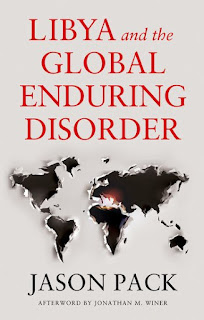
"Libya and the Global Enduring Disorder"

New from Oxford University Press: Libya and the Global Enduring Disorder by Jason Pack.

About the book, from the publisher:
We no longer inhabit a world governed by international coordination, a unified NATO bloc, or an American hegemon. Traditionally, the decline of one empire leads to a restoration in the balance of power, via a struggle among rival systems of order. Yet this dynamic is surprisingly absent today; instead, the superpowers have all, at times, sought to promote what Jason Pack terms the 'Enduring Disorder'.

He contends that Libya's ongoing conflict-more so than the civil wars in Yemen, Syria, Venezuela or Ukraine-constitutes the ideal microcosm in which to identify the salient features of this new era of geopolitics. The country's post-Qadhafi trajectory has been molded by the stark absence of coherent international diplomacy; while Libya's incremental implosion has precipitated cross-border contagion, further corroding global institutions and international partnership.

Pack draws on over two decades of research in and on Libya and Syria to highlight the Kafkaesque aspects of today's global affairs. He shows how even the threats posed by the Arab Spring, and the Benghazi assassination of US Ambassador J. Christopher Stevens, couldn't occasion a unified Western response. Rather, they have further undercut global collaboration, demonstrating the self-reinforcing nature of the progressively collapsing world order.
--Marshal Zeringue

Wednesday, February 2, 2022

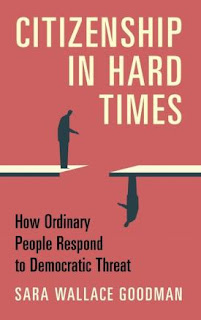
"Citizenship in Hard Times"

New from Cambridge University Press: Citizenship in Hard Times: How Ordinary People Respond to Democratic Threat by Sara Wallace Goodman.

About the book, from the publisher:
What do citizens do in response to threats to democracy? This book examines the mass politics of civic obligation in the US, UK, and Germany. Exploring threats like foreign interference in elections and polarization, Sara Wallace Goodman shows that citizens respond to threats to democracy as partisans, interpreting civic obligation through a partisan lens that is shaped by their country's political institutions. This divided, partisan citizenship makes democratic problems worse by eroding the national unity required for democratic stability. Employing novel survey experiments in a cross-national research design, Citizenship in Hard Times presents the first comprehensive and comparative analysis of citizenship norms in the face of democratic threat. In showing partisan citizens are not a reliable bulwark against democratic backsliding, Goodman identifies a key vulnerability in the mass politics of democratic order. In times of democratic crisis, defenders of democracy must work to fortify the shared foundations of democratic citizenship.
Follow Sara Wallace Goodman on Twitter.

--Marshal Zeringue

Tuesday, February 1, 2022

"Freeze!"

New from Cornell University Press: Freeze!: The Grassroots Movement to Halt the Arms Race and End the Cold War by Henry Richard Maar III.

About the book, from the publisher:
In Freeze!, Henry Richard Maar III chronicles the rise of the transformative and transnational Nuclear Weapons Freeze Campaign. Amid an escalating Cold War that pitted the nuclear arsenal of the United States against that of the Soviet Union, the grassroots peace movement emerged sweeping the nation and uniting people around the world.

The solution for the arms race that the Campaign proposed: a bilateral freeze on the building, testing, and deployment of nuclear weapons on the part of two superpowers of the US and the USSR. That simple but powerful proposition stirred popular sentiment and provoked protest in the streets and on screen from New York City to London to Berlin. Movie stars and scholars, bishops and reverends, governors and congress members, and, ultimately, US President Reagan and General Secretary Gorbachev took a stand for or against the Freeze proposal.

With the Reagan administration so openly discussing the prospect of winnable and survivable nuclear warfare like never before, the Freeze movement forcefully translated decades of private fears into public action. Drawing upon extensive archival research in recently declassified materials, Maar illuminates how the Freeze campaign demonstrated the power and importance of grassroots peace activism in all levels of society. The Freeze movement played an instrumental role in shaping public opinion and American politics, helping establish the conditions that would bring the Cold War to an end.
Visit Henry Richard Maar III's website.

--Marshal Zeringue