Tuesday, November 30, 2021

"The Dissolution of the Monasteries"

New from Yale University Press: The Dissolution of the Monasteries: A New History by James Clark.

About the book, from the publisher:
The first account of the dissolution of the monasteries for fifty years—exploring its profound impact on the people of Tudor England

Shortly before Easter, 1540 saw the end of almost a millennium of monastic life in England. Until then religious houses had acted as a focus for education, literary, and artistic expression and even the creation of regional and national identity. Their closure, carried out in just four years between 1536 and 1540, caused a dislocation of people and a disruption of life not seen in England since the Norman Conquest.

Drawing on the records of national and regional archives as well as archaeological remains, James Clark explores the little-known lives of the last men and women who lived in England’s monasteries before the Reformation. Clark challenges received wisdom, showing that buildings were not immediately demolished and Henry VIII’s subjects were so attached to the religious houses that they kept fixtures and fittings as souvenirs. This rich, vivid history brings back into focus the prominent place of abbeys, priories, and friaries in the lives of the English people.
--Marshal Zeringue

Monday, November 29, 2021

"Catastrophic Success"

New from Cornell University Press: Catastrophic Success: Why Foreign-Imposed Regime Change Goes Wrong by Alexander B. Downes.

About the book, from the publisher:
In Catastrophic Success, Alexander B. Downes compiles all instances of regime change around the world over the past two centuries. Drawing on this impressive data set, Downes shows that regime change increases the likelihood of civil war and violent leader removal in target states and fails to reduce the probability of conflict between intervening states and their targets. As Downes demonstrates, when a state confronts an obstinate or dangerous adversary, the lure of toppling its government and establishing a friendly administration is strong. The historical record, however, shows that foreign-imposed regime change is, in the long term, neither cheap, easy, nor consistently successful. The strategic impulse to forcibly oust antagonistic or non-compliant regimes overlooks two key facts. First, the act of overthrowing a foreign government sometimes causes its military to disintegrate, sending thousands of armed men into the countryside where they often wage an insurgency against the intervener. Second, externally-imposed leaders face a domestic audience in addition to an external one, and the two typically want different things. These divergent preferences place imposed leaders in a quandary: taking actions that please one invariably alienates the other. Regime change thus drives a wedge between external patrons and their domestic protégés or between protégés and their people. Catastrophic Success provides sober counsel for leaders and diplomats. Regime change may appear an expeditious solution, but states are usually better off relying on other tools of influence, such as diplomacy. Regime change, Downes urges, should be reserved for exceptional cases. Interveners must recognize that, absent a rare set of promising preconditions, regime change often instigates a new period of uncertainty and conflict that impedes their interests from being realized.
Visit Alexander B. Downes's website.

--Marshal Zeringue

Sunday, November 28, 2021

"Power to the People"

New from Oxford University Press: Power to the People: Constitutionalism in the Age of Populism by Mark Tushnet and Bojan Bugarič.

About the book, from the publisher:
Self-described populist leaders around the world are dismantling their nation's constitutions. This has led to a widespread view that populism as such is inconsistent with constitutionalism. This book proposes that some forms of populism are inconsistent with constitutionalism, while others aren't. Context and detail matter.

Power to the People offers a thin definition of constitutionalism that people from the progressive left to the conservative right should be able to agree on even if they would supplement the thin definition withn other more partisan ideas. This is followed by a similarly basic definition of populism. Comparing the two, this book argues that one facet of populism -its suspicion of institutions that are strongly entrenched against change by political majorities-is sometimes inconsistent with constitutionalism'sbthinly understood definition.

The book provides a series of case studies, some organized by nation, others by topic, to identify, more precisely, when and how populist programs are inconsistent with constitutionalism-and, importantly, when and how they are not. Concluding with a discussion of the possibilities for a deeper, populist democracy, the book examines recent challenges to the idea that democracy is a good form of government by exploring possibilities for new, albeit revisable, institutions that can determine and implement a majority's views without always threatening constitutionalism.
The Page 99 Test: Mark Tushnet's Taking Back the Constitution.

--Marshal Zeringue

Saturday, November 27, 2021

"Zwingli: God's Armed Prophet"

New from Yale University Press: Zwingli: God's Armed Prophet by Bruce Gordon.

About the book, from the publisher:
A major new biography of Huldrych Zwingli—the warrior preacher who shaped the early Reformation

Huldrych Zwingli (1484–1531) was the most significant early reformer after Martin Luther. As the architect of the Reformation in Switzerland, he created the Reformed tradition later inherited by John Calvin. His movement ultimately became a global religion. A visionary of a new society, Zwingli was also a divisive and fiercely radical figure.

Bruce Gordon presents a fresh interpretation of the early Reformation and the key role played by Zwingli. A charismatic preacher and politician, Zwingli transformed church and society in Zurich and inspired supporters throughout Europe. Yet, Gordon shows, he was seen as an agitator and heretic by many and his bellicose, unyielding efforts to realize his vision would prove his undoing. Unable to control the movement he had launched, Zwingli died on the battlefield fighting his Catholic opponents.
Bruce Gordon is Titus Street Professor of Ecclesiastical History at Yale University. He has written widely on early modern history and religion. He is the author of Calvin, The Swiss Reformation, and John Calvin’s Institutes of the Christian Religion.

--Marshal Zeringue

Friday, November 26, 2021

"Gender Threat"

New from Stanford University Press: Gender Threat: American Masculinity in the Face of Change by Dan Cassino and Yasemin Besen-Cassino.

About the book, from the publisher:
Against all evidence to the contrary, American men have come to believe that the world is tilted – economically, socially, politically – against them. A majority of men across the political spectrum feel that they face some amount of discrimination because of their sex. The authors of Gender Threat look at what reasoning lies behind their belief and how they respond to it. Many feel that there is a limited set of socially accepted ways for men to express their gender identity, and when circumstances make it difficult or impossible for them to do so, they search for another outlet to compensate. Sometimes these behaviors are socially positive, such as placing a greater emphasis on fatherhood, but other times they can be maladaptive, as in the case of increased sexual harassment at work. These trends have emerged, notably, since the Great Recession of 2008-09. Drawing on multiple data sources, the authors find that the specter of threats to their gender identity has important implications for men's behavior. Importantly, younger men are more likely to turn to nontraditional compensatory behaviors, such as increased involvement in cooking, parenting, and community leadership, suggesting that the conception of masculinity is likely to change in the decades to come.
--Marshal Zeringue

Thursday, November 25, 2021

"Outrageous!: The Story of Section 28 and Britain's Battle for LGBT Education"

Coming January 24, 2022 from Reaktion Books: Outrageous!: The Story of Section 28 and Britain's Battle for LGBT Education by Paul Baker.

About the book, from the publisher:
A personal and impassioned history of the infamous Section 28, the 1988 UK law banning the teaching “of the acceptability of homosexuality.”

On May 23, 1988, Paul Baker sat down with his family to eat cake on his sixteenth birthday while The Six O’Clock News played in the background. But something was not quite right. There was muffled shouting—“Stop Section 28!”—and a scuffle. The papers would announce: “Beeb Man Sits on Lesbian.”

The next day Section 28 passed into UK law, forbidding local authorities from the teaching “of the acceptability of homosexuality as a pretended family relationship.” It would send shockwaves through British society: silencing gay pupils and teachers, while galvanizing mass protests and the formation of the LGBTQ+ rights groups OutRage! and Stonewall.

Outrageous! tells its story: the background to the Act, how the press fanned the flames and what politicians said during debates, how protestors fought back to bring about the repeal of the law in the 2000s, and its eventual legacy. Based on detailed research, interviews with key figures—including Ian McKellen, Michael Cashman, and Angela Mason—and personal recollection, Outrageous! is an impassioned, warm, often moving account of unthinkable prejudice enshrined within the law and of the power of community to overcome it.
--Marshal Zeringue

Wednesday, November 24, 2021

"Kashmir at the Crossroads"

New from Yale University Press: Kashmir at the Crossroads: Inside a 21st-Century Conflict by Sumantra Bose.

About the book, from the publisher:
An authoritative, fresh, and vividly written account of the Kashmir conflict—from 1947 to the present

The India-Pakistan dispute over Kashmir is one of the world’s incendiary conflicts. Since 1990, at least 60,000 people have been killed—insurgents, civilians, and military and police personnel. In 2019, the conflict entered a dangerous new phase. India’s Hindu nationalist government, under Narendra Modi, repealed Indian-administered Jammu and Kashmir’s autonomous status and divided it into two territories subject to New Delhi’s direct rule. The drastic move was accompanied by mass arrests and lengthy suspension of mobile and internet services.

In this definitive account, Sumantra Bose examines the conflict in Kashmir from its origins to the present volatile juncture. He explores the global context of the current situation, including China’s growing role, as well as the human tragedy of the people caught in the bitter dispute. Drawing on three decades of field experience in Kashmir, Bose asks whether a compromise settlement is still possible given the ascendancy of Hindu nationalism in India and the complex geopolitical context.
Visit Sumantra Bose's website.

--Marshal Zeringue

Tuesday, November 23, 2021

"The Queerness of Home"

New from the University of Chicago Press: The Queerness of Home: Gender, Sexuality, and the Politics of Domesticity after World War II by Stephen Vider.

About the book, from the publisher:
>Vider uncovers how LGBTQ people reshaped domestic life in the postwar United States.

From the Stonewall riots to the protests of ACT UP, histories of queer and trans politics have almost exclusively centered on public activism. In The Queerness of Home, Stephen Vider turns the focus inward, showing that the intimacy of domestic space has been equally crucial to the history of postwar LGBTQ life.

Beginning in the 1940s, LGBTQ activists looked increasingly to the home as a site of connection, care, and cultural inclusion. They struggled against the conventions of marriage, challenged the gendered codes of everyday labor, reimagined domestic architecture, and contested the racial and class boundaries of kinship and belonging. Retelling LGBTQ history from the inside out, Vider reveals the surprising ways that the home became, and remains, a charged space in battles for social and economic justice, making it clear that LGBTQ people not only realized new forms of community and culture for themselves—they remade the possibilities of home life for everyone.
Visit Stephen Vider's website.

--Marshal Zeringue

Monday, November 22, 2021

"Why Privacy Matters"

New from Oxford University Press: Why Privacy Matters by Neil Richards.

About the book, from the publisher:
A much-needed corrective on what privacy is, why it matters, and how we can protect in an age when so many believe that the concept is dead.

Everywhere we look, companies and governments are spying on us--seeking information about us and everyone we know. Ad networks monitor our web-surfing to send us "more relevant" ads. The NSA screens our communications for signs of radicalism. Schools track students' emails to stop school shootings. Cameras guard every street corner and traffic light, and drones fly in our skies. Databases of human information are assembled for purposes of "training" artificial intelligence programs designed to predict everything from traffic patterns to the location of undocumented migrants. We're even tracking ourselves, using personal electronics like Apple watches, Fitbits, and other gadgets that have made the "quantified self" a realistic possibility. As Facebook's Mark Zuckerberg once put it, "the Age of Privacy is over." But Zuckerberg and others who say "privacy is dead" are wrong. In Why Privacy Matters, Neil Richards explains that privacy isn't dead, but rather up for grabs.

Richards shows how the fight for privacy is a fight for power that will determine what our future will look like, and whether it will remain fair and free. If we want to build a digital society that is consistent with our hard-won commitments to political freedom, individuality, and human flourishing, then we must make a meaningful commitment to privacy. Privacy matters because good privacy rules can promote the essential human values of identity, power, freedom, and trust. If we want to preserve our commitments to these precious yet fragile values, we will need privacy rules. Richards explains why privacy remains so important and offers strategies that can help us protect it from the forces that are working to undermine it. Pithy and forceful, this is essential reading for anyone interested in a topic that sits at the center of so many current problems.
--Marshal Zeringue

Sunday, November 21, 2021

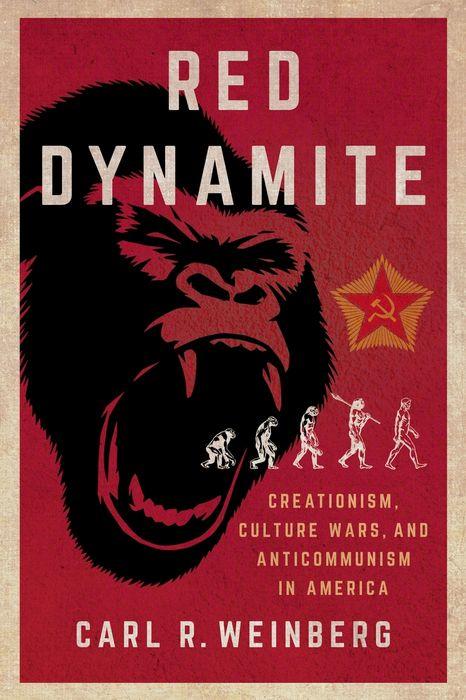
"Red Dynamite"

New from Cornell University Press: Red Dynamite: Creationism, Culture Wars, and Anticommunism in America by Carl R. Weinberg.

About the book, from the publisher:
In Red Dynamite, Carl R. Weinberg argues that creationism's tenacious hold on American public life depended on culture-war politics inextricably embedded in religion. Many Christian conservatives were convinced that evolutionary thought promoted immoral and even bestial social, sexual, and political behavior. The "fruits" of subscribing to Darwinism were, in their minds, a dangerous rearrangement of God-given standards and the unsettling of traditional hierarchies of power. Despite claiming to focus exclusively on science and religion, creationists were practicing politics. Their anticommunist campaign, often infused with conspiracy theory, gained power from the fact that the Marxist founders, the early Bolshevik leaders, and their American allies were staunch evolutionists.

Using the Scopes "Monkey" Trial as a starting point, Red Dynamite traces the politically explosive union of Darwinism and communism over the next century. Across those years, social evolution was the primary target of creationists, and their "ideas have consequences" strategy instilled fear that shaped the contours of America's culture wars. By taking the anticommunist arguments of creationists seriously, Weinberg reveals a neglected dimension of antievolutionism and illuminates a source of the creationist movement's continuing strength.
Follow Carl R. Weinberg on Twitter and visit his website.

--Marshal Zeringue