Monday, May 10, 2021

"We the Gamers"

New from Oxford University Press: We the Gamers: How Games Teach Ethics and Civics by Karen Schrier.

About the book, from the publisher:
Distrust. Division. Disparity. Is our world in disrepair?

Ethics and civics have always mattered, but perhaps they matter now more than ever before. Recently, with the rise of online teaching and movements like #PlayApartTogether, games have become increasingly acknowledged as platforms for civic deliberation and value sharing. We the Gamers explores these possibilities by examining how we connect, communicate, analyze, and discover when we play games. Combining research-based perspectives and current examples, this volume shows how games can be used in ethics, civics, and social studies education to inspire learning, critical thinking, and civic change.

We the Gamers introduces and explores various educational frameworks through a range of games and interactive experiences including board and card games, online games, virtual reality and augmented reality games, and digital games like Minecraft, Executive Command, Keep Talking and Nobody Explodes, Fortnite, When Rivers Were Trails, Politicraft, Quandary, and Animal Crossing: New Horizons. The book systematically evaluates the types of skills, concepts, and knowledge needed for civic and ethical engagement, and details how games can foster these skills in classrooms, remote learning environments, and other educational settings. We the Gamers also explores the obstacles to learning with games and how to overcome those obstacles by encouraging equity and inclusion, care and compassion, and fairness and justice.

Featuring helpful tips and case studies, We the Gamers shows teachers the strengths and limitations of games in helping students connect with civics and ethics, and imagines how we might repair and remake our world through gaming, together.
Visit Karen Schrier's website.

--Marshal Zeringue

Sunday, May 9, 2021

"Imagining Persecution"

New from Rutgers University Press: Imagining Persecution: Why American Christians Believe There Is a Global War against Their Faith by Jason Bruner.

About the book, from the publisher:
Many American Christians have come to understand their relationship to other Christian denominations and traditions through the lens of religious persecution. This book provides a historical account of these developments, showing the global, theological, and political changes that made it possible for contemporary Christians to claim that there is a global war on Christians. Bruner does not advocate on behalf of particular repressed Christian communities, nor does it argue for the genuineness of certain Christians’ claims of persecution. Instead, this book is the first to examine the idea that there is a “global war on Christians” and its analytical implications. It does so by giving a concise history of categories such as "martyr" and theologies that have come together to produce a global Christian imagination premised upon the notion of shared suffering for one’s faith. This history does not deny certain instances of suffering or death; rather, it sets out to reflect upon and make meaning of the consequences for thinking about religious violence and Christianity worldwide using terms such as a “global war on Christians.”
Jason Bruner is an associate professor of global Christianity in the School of Historical, Philosophical, and Religious Studies at Arizona State University in Tempe. He is author of Living Salvation in the East African Revival in Uganda.

--Marshal Zeringue

Saturday, May 8, 2021

"Feeling Like It"

New from Oxford University Press: Feeling Like It: A Theory of Inclination and Will by Tamar Schapiro.

About the book, from the publisher:
You may have an inclination to do it, but there is still a moment when you can decide to do it or not. This "moment of drama" is more puzzling than it first appears. When you are inclined to do something, are you related to your inclination as rider to horse? As ruler to subject? As thinker to thoughts? Schapiro shows that these familiar pictures fail to confront the central puzzle. Inclinations are motives with respect to which we are distinctively passive. But to be motivated is to be active—to be self-moved. How can you be passive in relation to your own activity? Schapiro puts forward an "inner animal" view, inspired by Kant, which holds that when you are merely inclined to act, the instinctive part of yourself is already active, while the rest of you is not. At this moment, your will is at a crossroads. You can humanize your inclination, or you can dehumanize yourself. Feeling Like It provides a concise and accessible investigation of a new problem at the intersection of ethics, philosophy of action, and philosophy of mind.
Tamar Schapiro holds a BA from Yale and a PhD in Philosophy from Harvard. She taught in the department of philosophy at Stanford for many years before joining MIT, where she is currently Associate Professor of Philosophy. She has published articles on Kantian ethics, the theory of action, and motivational psychology.

--Marshal Zeringue

Friday, May 7, 2021

"American Health Crisis"

New from the University of California Press: American Health Crisis: One Hundred Years of Panic, Planning, and Politics by Martin Halliwell.

About the book, from the publisher:
A history of U.S. public health emergencies and how we can turn the tide.

Despite enormous advances in medical science and public health education over the last century, access to health care remains a dominant issue in American life. U.S. health care is often hailed as the best in the world, yet the public health emergencies of today often echo the public health emergencies of yesterday: consider the Great Influenza Pandemic of 1918–19 and COVID-19, the displacement of the Dust Bowl and the havoc of Hurricane Maria, the Reagan administration’s antipathy toward the AIDS epidemic and the lack of accountability during the water crisis in Flint, Michigan.

Spanning the period from the presidency of Woodrow Wilson to that of Donald Trump, American Health Crisis illuminates how—despite the elevation of health care as a human right throughout the world—vulnerable communities in the United States continue to be victimized by structural inequalities across disparate geographies, income levels, and ethnic groups. Martin Halliwell views contemporary public health crises through the lens of historical and cultural revisionings, suturing individual events together into a narrative of calamity that has brought us to our current crisis in health politics. American Health Crisis considers the future of public health in the United States and, presenting a reinvigorated concept of health citizenship, argues that now is the moment to act for lasting change.
--Marshal Zeringue

Thursday, May 6, 2021

"Running Out"

New from Princeton University Press: Running Out: In Search of Water on the High Plains by Lucas Bessire.

About the book, from the publisher:
The Ogallala aquifer has nourished life on the American Great Plains for millennia. But less than a century of unsustainable irrigation farming has taxed much of the aquifer beyond repair. The imminent depletion of the Ogallala and other aquifers around the world is a defining planetary crisis of our times. Running Out offers a uniquely personal account of aquifer depletion and the deeper layers through which it gains meaning and force.

Anthropologist Lucas Bessire journeyed back to western Kansas, where five generations of his family lived as irrigation farmers and ranchers, to try to make sense of this vital resource and its loss. His search for water across the drying High Plains brings the reader face to face with the stark realities of industrial agriculture, eroding democratic norms, and surreal interpretations of a looming disaster. Yet the destination is far from predictable, as the book seeks to move beyond the words and genres through which destruction is often known. Instead, this journey into the morass of eradication offers a series of unexpected discoveries about what it means to inherit the troubled legacies of the past and how we can take responsibility for a more inclusive, sustainable future.

An urgent and unsettling meditation on environmental change, Running Out is a revelatory account of family, complicity, loss, and what it means to find your way back home.
Visit Lucas Bessire's website.

--Marshal Zeringue

Wednesday, May 5, 2021

"The Ambivalence of Gay Liberation"

New from Oxford University Press: The Ambivalence of Gay Liberation: Male Homosexual Politics in 1970s West Germany by Craig Griffiths.

About the book, from the publisher:
The Ambivalence of Gay Liberation explores ways of thinking, feeling, and talking about being gay in the 1970s, an influential decade sandwiched between the partial decriminalisation of male homosexuality in 1969, and the arrival of the HIV/AIDS crisis in the early 1980s. Moving beyond divided Cold War Berlin, it also focuses on lesser-known cities, such as Aachen, Cologne, Frankfurt, Münster, and Stuttgart, to name just a few of the 53 localities that were home to a gay group by the end of the 1970s. These groups were important, and this book tells their story.

In 1970s West Germany gay liberation did not take place only in activist meetings, universities, and on street demonstrations, but also on television, in magazine editorial offices, ordinary homes, bedrooms, and beyond. In considering all these spaces and individuals, this book provides a more complex account than previous histories, which have tended to focus only on a social movement and only on the idea of 'gay pride'. By drawing attention to ambivalence, this book shows that gay liberation was never only about pride, but also about shame; characterized not only by hope, but also by fear; and driven forward not just by the pushes of confrontation, but also by the pulls of conformism. Ranging from the painstaking emergence of the gay press to the first representation of homosexuality on television, from debates over the sexual legacy of 1968 and the student movement to the memory of Nazi persecution, The Ambivalence of Gay Liberation is the first English-language book to tell the story of male homosexual politics in 1970s West Germany. In doing so, this book changes the way we think about modern queer history.
--Marshal Zeringue

Tuesday, May 4, 2021

"By Executive Order"

New from Princeton University Press: By Executive Order: Bureaucratic Management and the Limits of Presidential Power by Andrew Rudalevige.

About the book, from the publisher:
How the executive branch—not the president alone—formulates executive orders, and how this process constrains the chief executive's ability to act unilaterally

The president of the United States is commonly thought to wield extraordinary personal power through the issuance of executive orders. In fact, the vast majority of such orders are proposed by federal agencies and shaped by negotiations that span the executive branch. By Executive Order provides the first comprehensive look at how presidential directives are written—and by whom.

In this eye-opening book, Andrew Rudalevige examines more than five hundred executive orders from the 1930s to today—as well as more than two hundred others negotiated but never issued—shedding vital new light on the multilateral process of drafting supposedly unilateral directives. He draws on a wealth of archival evidence from the Office of Management and Budget and presidential libraries as well as original interviews to show how the crafting of orders requires widespread consultation and compromise with a formidable bureaucracy. Rudalevige explains the key role of management in the presidential skill set, detailing how bureaucratic resistance can stall and even prevent actions the chief executive desires, and how presidents must bargain with the bureaucracy even when they seek to act unilaterally.

Challenging popular conceptions about the scope of presidential power, By Executive Order reveals how the executive branch holds the power to both enact and constrain the president’s will.
Follow Andrew Rudalevige on Twitter.

--Marshal Zeringue

Monday, May 3, 2021

"The Cold War from the Margins"

New from Cornell University Press: The Cold War from the Margins: A Small Socialist State on the Global Cultural Scene by Theodora K. Dragostinova.

About the book, from the publisher:
In The Cold War from the Margins, Theodora K. Dragostinova reappraises the global 1970s from the perspective of a small socialist state—Bulgaria—and its cultural engagements with the Balkans, the West, and the Third World. During this anxious decade, Bulgaria's communist leadership invested heavily in cultural diplomacy to bolster its legitimacy at home and promote its agendas abroad. Bulgarians traveled the world to open museum exhibitions, show films, perform music, and showcase the cultural heritage and future aspirations of their "ancient yet modern" country.

As Dragostinova shows, these encounters transcended the Cold War's bloc mentality: Bulgaria's relations with Greece and Austria warmed, émigrés once considered enemies were embraced, and new cultural ties were forged with India, Mexico, and Nigeria. Pursuing contact with the West and solidarity with the Global South boosted Bulgaria's authoritarian regime by securing new allies and unifying its population. Complicating familiar narratives of both the 1970s and late socialism, The Cold War from the Margins places the history of socialism in an international context and recovers alternative models of global interconnectivity along East-South lines.
Follow Theodora Dragostinova on Twitter.

--Marshal Zeringue

Sunday, May 2, 2021

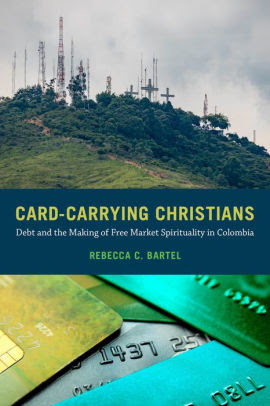
"Card-Carrying Christians"

New from the University of California Press: Card-Carrying Christians: Debt and the Making of Free Market Spirituality in Colombia by Rebecca C. Bartel.

About the book, from the publisher:
In the waning years of Latin America's longest and bloodiest civil war, the rise of an unlikely duo is transforming Colombia: Christianity and access to credit. In her exciting new book, Rebecca C. Bartel details how surging evangelical conversions and widespread access to credit cards, microfinance programs, and mortgages are changing how millions of Colombians envision a more prosperous future. Yet programs of financialization propel new modes of violence. As prosperity becomes conflated with peace, and debt with devotion, survival only becomes possible through credit and its accompanying forms of indebtedness. A new future is on the horizon, but it will come at a price.
Rebecca C. Bartel is Assistant Professor in the Department of Religious Studies and Associate Director for the Center for Latin American Studies at San Diego State University.

--Marshal Zeringue

Saturday, May 1, 2021

"Life after Gravity"

New from Oxford University Press: Life after Gravity: Isaac Newton's London Career by Patricia Fara.

About the book, from the publisher:
The story of Isaac Newton's decades in London - as ambitious cosmopolitan gentleman, President of London's Royal Society, Master of the Mint, and investor in the slave trade.

Isaac Newton is celebrated throughout the world as a great scientific genius who conceived the theory of gravity. But in his early fifties, he abandoned his life as a reclusive university scholar to spend three decades in London, a long period of metropolitan activity that is often overlooked. Enmeshed in Enlightenment politics and social affairs, Newton participated in the linked spheres of early science and imperialist capitalism. Instead of the quiet cloisters and dark libraries of Cambridge's all-male world, he now moved in fashionable London society, which was characterized by patronage relationships, sexual intrigues and ruthless ambition.

Knighted by Queen Anne, and a close ally of influential Whig politicians, Newton occupied a powerful position as President of London's Royal Society. He also became Master of the Mint, responsible for the nation's money at a time of financial crisis, and himself making and losing small fortunes on the stock market. A major investor in the East India Company, Newton benefited from the global trading networks that relied on selling African captives to wealthy plantation owners in the Americas, and was responsible for monitoring the import of African gold to be melted down for English guineas.

Patricia Fara reveals Newton's life as a cosmopolitan gentleman by focussing on a Hogarth painting of an elite Hanoverian drawing room. Gazing down from the mantelpiece, a bust of Newton looms over an aristocratic audience watching their children perform a play about European colonialism and the search for gold. Packed with Newtonian imagery, this conversation piece depicts the privileged, exploitative life in which this eminent Enlightenment figure engaged, an uncomfortable side of Newton's life with which we are much less familiar.
The Page 99 Test: Erasmus Darwin.

The Page 99 Test: A Lab of One's Own.

--Marshal Zeringue