Tuesday, December 10, 2013

"Yankel's Tavern"

New from Oxford University Press: Yankel's Tavern: Jews, Liquor, and Life in the Kingdom of Poland by Glenn Dynner.

About the book, from the publisher:
In nineteenth-century Eastern Europe, the Jewish-run tavern was often the center of leisure, hospitality, business, and even religious festivities. This unusual situation came about because the nobles who owned taverns throughout the formerly Polish lands believed that only Jews were sober enough to run taverns profitably, a belief so ingrained as to endure even the rise of Hasidism's robust drinking culture. As liquor became the region's boom industry, Jewish tavernkeepers became integral to both local economies and local social life, presiding over Christian celebrations and dispensing advice, medical remedies and loans. Nevertheless, reformers and government officials, blaming Jewish tavernkeepers for epidemic peasant drunkenness, sought to drive Jews out of the liquor trade. Their efforts were particularly intense and sustained in the Kingdom of Poland, a semi-autonomous province of the Russian empire that was often treated as a laboratory for social and political change. Historians have assumed that this spelled the end of the Polish Jewish liquor trade. However, newly discovered archival sources demonstrate that many nobles helped their Jewish tavernkeepers evade fees, bans and expulsions by installing Christians as fronts for their taverns. The result-a vast underground Jewish liquor trade-reflects an impressive level of local Polish-Jewish co-existence that contrasts with the more familiar story of anti-Semitism and violence. By tapping into sources that reveal the lives of everyday Jews and Christians in the Kingdom of Poland, Yankel's Tavern transforms our understanding of the region during the tumultuous period of Polish uprisings and Jewish mystical revival.
--Marshal Zeringue

Monday, December 9, 2013

"Rhinestones, Religion, and the Republic"

New from Stanford University Press: Rhinestones, Religion, and the Republic: Fashioning Jewishness in France by Kimberly Arkin.

About the book, from the publisher:
During the course of her fieldwork in Paris, anthropologist Kimberly Arkin heard what she thought was a surprising admission. A French-born, North African Jewish (Sephardi) teenage girl laughingly told Arkin she was a racist. When asked what she meant by that, the girl responded, "It means I hate Arabs."

This girl was not unique. She and other Sephardi youth in Paris insisted, again and again, that they were not French, though born in France, and that they could not imagine their Jewish future in France. Fueled by her candid and compelling informants, Arkin's analysis delves into the connections and disjunctures between Jews and Muslims, religion and secular Republicanism, race and national community, and identity and culture in post-colonial France. Rhinestones argues that Sephardi youth, as both "Arabs" and "Jews," fall between categories of class, religion, and culture. Many reacted to this liminality by going beyond religion and culture to categorize their Jewishness as race, distinguishing Sephardi Jews from "Arab" Muslims, regardless of similarities they shared, while linking them to "European" Jews (Ashkenazim), regardless of their differences. But while racializing Jewishness might have made Sephardi Frenchness possible, it produced the opposite result: it re-grounded national community in religion-as-race, thereby making pluri-religious community appear threatening. Rhinestones thus sheds light on the production of race, alienation, and intolerance within marginalized French and European populations.
--Marshal Zeringue

Sunday, December 8, 2013

"Washington Brotherhood"

New from The University of North Carolina Press: Washington Brotherhood: Politics, Social Life, and the Coming of the Civil War by Rachel A. Shelden.

About the book, from the publisher:
Traditional portrayals of politicians in antebellum Washington, D.C., describe a violent and divisive society, full of angry debates and violent duels, a microcosm of the building animosity throughout the country. Yet, in Washington Brotherhood, Rachel Shelden paints a more nuanced portrait of Washington as a less fractious city with a vibrant social and cultural life. Politicians from different parties and sections of the country interacted in a variety of day-to-day activities outside traditional political spaces and came to know one another on a personal level. Shelden shows that this engagement by figures such as Stephen Douglas, John Crittenden, Abraham Lincoln, and Alexander Stephens had important consequences for how lawmakers dealt with the sectional disputes that bedeviled the country during the 1840s and 1850s--particularly disputes involving slavery in the territories.

Shelden uses primary documents--from housing records to personal diaries--to reveal the ways in which this political sociability influenced how laws were made in the antebellum era. Ultimately, this Washington "bubble" explains why so many of these men were unprepared for secession and war when the winter of 1860-61 arrived.
--Marshal Zeringue

Saturday, December 7, 2013

"In Praise of Desire"

New from Oxford University Press: In Praise of Desire by Nomy Arpaly and Timothy Schroeder.

About the book, from the publisher:
Joining the ancient debate over the roles of reason and appetite in the moral mind, In Praise of Desire takes the side of appetite. Acting for moral reasons, acting in a praiseworthy manner, and acting out of virtue amount to nothing more than acting out of intrinsic desires for the right or the good, correctly conceived.

Reason, understood as the power to deliberate about what to think and do, is shown not to be the basis for our ability to act for reasons. Reason is rather the ability to perform certain mental actions which help us to become settled about what to think or do, and these actions are in turn motivated by desire. Thus reason is, if not a slave of the passions, then at least a useful tool deployed by desiring agents.

If desire were merely an impulse to act, then a moral psychology built on intrinsic desires might be unpromising. But intrinsic desire is much more than an impulse to act. Intrinsic desires are a natural kind, states of the brain which contingently but commonly cause impulses to act, as well as causing a rich array of feelings and cognitive effects (on attention, learning, and more). Understood in this way, intrinsic desires are more central to agency, good will, and virtue than any mere impulse could be.

In Praise of Desire shows that a desire-centered moral psychology can be richer than philosophers commonly think, accommodating the full complexity of moral life.
--Marshal Zeringue

Friday, December 6, 2013

"Living in Infamy"

New from Oxford University Press: Living in Infamy: Felon Disfranchisement and the History of American Citizenship by Pippa Holloway.

About the book, from the publisher:
Living in Infamy: Felon Disfranchisement and the History of American Citizenship examines the history of disfranchisement for criminal conviction in the United States during the late 19th and early 20th centuries. In the post-war South, white southern Democrats expanded the usage of laws disfranchising for crimes of infamy in order to deny African Americans the suffrage rights due them as citizens, employing historical similarities between the legal statuses of slaves and convicts as justification. At the same time, our nation's criminal code changed. The inhumane treatment of prisoners, the expansion of the prison system, the public nature of punishment by forced labor, and the abandonment of the idea of reform and rehabilitation of prisoners all contributed to a national consensus that certain categories of criminals should be permanently disfranchised.

As racial barriers to suffrage were challenged and fell, rights remained restricted for persons targeted by such infamy laws. Criminal convictions-in place of race-continued the disparity in legal status between whites and African Americans. Decades later, after race-based disfranchisement has officially ended, legislation steeped in a legacy of racial discrimination continues to perpetuate a dichotomy of suffrage and citizenship that is still effecting our election outcomes today.
--Marshal Zeringue

Thursday, December 5, 2013

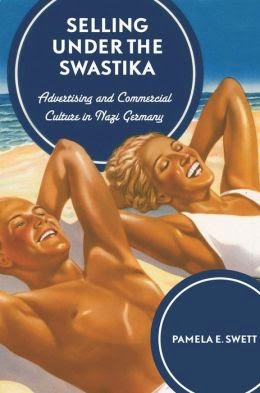
"Selling under the Swastika"

New from Stanford University Press: Selling under the Swastika: Advertising and Commercial Culture in Nazi Germany by Pamela Swett.

About the book, from the publisher:
Selling under the Swastika is the first in-depth study of commercial advertising in the Third Reich. While scholars have focused extensively on the political propaganda that infused daily life in Nazi Germany, they have paid little attention to the role played by commercial ads and sales culture in legitimizing and stabilizing the regime. Historian Pamela Swett explores the extent of the transformation of the German ads industry from the internationally infused republican era that preceded 1933 through the relative calm of the mid-1930s and into the war years. She argues that advertisements helped to normalize the concept of a "racial community," and that individual consumption played a larger role in the Nazi worldview than is often assumed. Furthermore, Selling under the Swastika demonstrates that commercial actors at all levels, from traveling sales representatives to company executives and ad designers, enjoyed relative independence as they sought to enhance their professional status and boost profits through the manipulation of National Socialist messages.
--Marshal Zeringue

Wednesday, December 4, 2013

"Ship of Death"

New from Yale University Press: Ship of Death: A Voyage That Changed the Atlantic World by Billy G. Smith.

About the book, from the publisher:
It is no exaggeration to say that the Hankey, a small British ship that circled the Atlantic in 1792 and 1793, transformed the history of the Atlantic world. This extraordinary book uncovers the long-forgotten story of the Hankey, from its altruistic beginnings to its disastrous end, and describes the ship’s fateful impact upon people from West Africa to Philadelphia, Haiti to London.

Billy G. Smith chased the story of the Hankey from archive to archive across several continents, and he now brings back to light a saga that continues to haunt the modern world. It began with a group of high-minded British colonists who planned to establish a colony free of slavery in West Africa. With the colony failing, the ship set sail for the Caribbean and then North America, carrying, as it turned out, mosquitoes infected with yellow fever. The resulting pandemic as the Hankey traveled from one port to the next was catastrophic. In the United States, tens of thousands died in Philadelphia, New York, Boston, and Charleston. The few survivors on the Hankey eventually limped back to London, hopes dashed and numbers decimated. Smith links the voyage and its deadly cargo to some of the most significant events of the era—the success of the Haitian slave revolution, Napoleon’s decision to sell the Louisiana Territory, a change in the geopolitical situation of the new United States—and spins a riveting tale of unintended consequences and the legacy of slavery that will not die.
--Marshal Zeringue

Tuesday, December 3, 2013

"Heir to the Empire City"

New from Basic Books: Heir to the Empire City: New York and the Making of Theodore Roosevelt by Edward P. Kohn.

About the book, from the publisher:
Theodore Roosevelt is best remembered as America's prototypical cowboy president — a Rough Rider who derived his political wisdom from a youth spent in the untamed American West. But while the great outdoors certainly shaped Roosevelt's identity, historian Edward P. Kohn argues that it was his hometown of New York that made him the progressive president we celebrate today. During his early political career, Roosevelt took on local Republican factions and Tammany Hall Democrats alike, proving his commitment to reform at all costs. He combated the city's rampant corruption, and helped to guide New York through the perils of rabid urbanization and the challenges of accommodating an influx of immigrants — experiences that would serve him well as president of the United States.

A riveting account of a man and a city on the brink of greatness, Heir to the Empire City reveals that Roosevelt's true education took place not in the West but on the mean streets of nineteenth-century New York.
--Marshal Zeringue

Monday, December 2, 2013

"Truly Human Enhancement"

New from the MIT Press: Truly Human Enhancement: A Philosophical Defense of Limits by Nicholas Agar.

About the book, from the publisher:
The transformative potential of genetic and cybernetic technologies to enhance human capabilities is most often either rejected on moral and prudential grounds or hailed as the future salvation of humanity. In this book, Nicholas Agar offers a more nuanced view, making a case for moderate human enhancement—improvements to attributes and abilities that do not significantly exceed what is currently possible for human beings. He argues against radical human enhancement, or improvements that greatly exceeds current human capabilities.

Agar explores notions of transformative change and motives for human enhancement; distinguishes between the instrumental and intrinsic value of enhancements; argues that too much enhancement undermines human identity; considers the possibility of cognitively enhanced scientists; and argues against radical life extension. Making the case for moderate enhancement, Agar argues that many objections to enhancement are better understood as directed at the degree of enhancement rather than enhancement itself. Moderate human enhancement meets the requirement of truly human enhancement. By radically enhancing human cognitive capabilities, by contrast, we may inadvertently create beings (“post-persons") with moral status higher than that of persons. If we create beings more entitled to benefits and protections against harms than persons, Agar writes, this will be bad news for the unenhanced. Moderate human enhancement offers a more appealing vision of the future and of our relationship to technology.
Visit Nicholas Agar's website.

--Marshal Zeringue

Sunday, December 1, 2013

"A Dreadful Deceit"

New from Basic Books: A Dreadful Deceit: The Myth of Race from the Colonial Era to Obama's America by Jacqueline Jones.

About the book, from the publisher:
In 1656, a planter in colonial Maryland tortured and killed one of his slaves, an Angolan man named Antonio who refused to work the fields. Over three centuries later, a Detroit labor organizer named Simon Owens watched as strikebreakers wielding bats and lead pipes beat his fellow autoworkers for protesting their inhumane working conditions. Antonio and Owens had nothing in common but the color of their skin and the economic injustices they battled—yet the former is what defines them in America’s consciousness. In A Dreadful Deceit, award-winning historian Jacqueline Jones traces the lives of these two men and four other African Americans to reveal how the concept of race has obscured the factors that truly divide and unite us.

Expansive, visionary, and provocative, A Dreadful Deceit explodes the pernicious fiction that has shaped American history.
--Marshal Zeringue